
Robust ground cover to enable resilient low rainfall mixed farms
Summary
Seed priming (SARDI Minnipa Agricultural Centre)
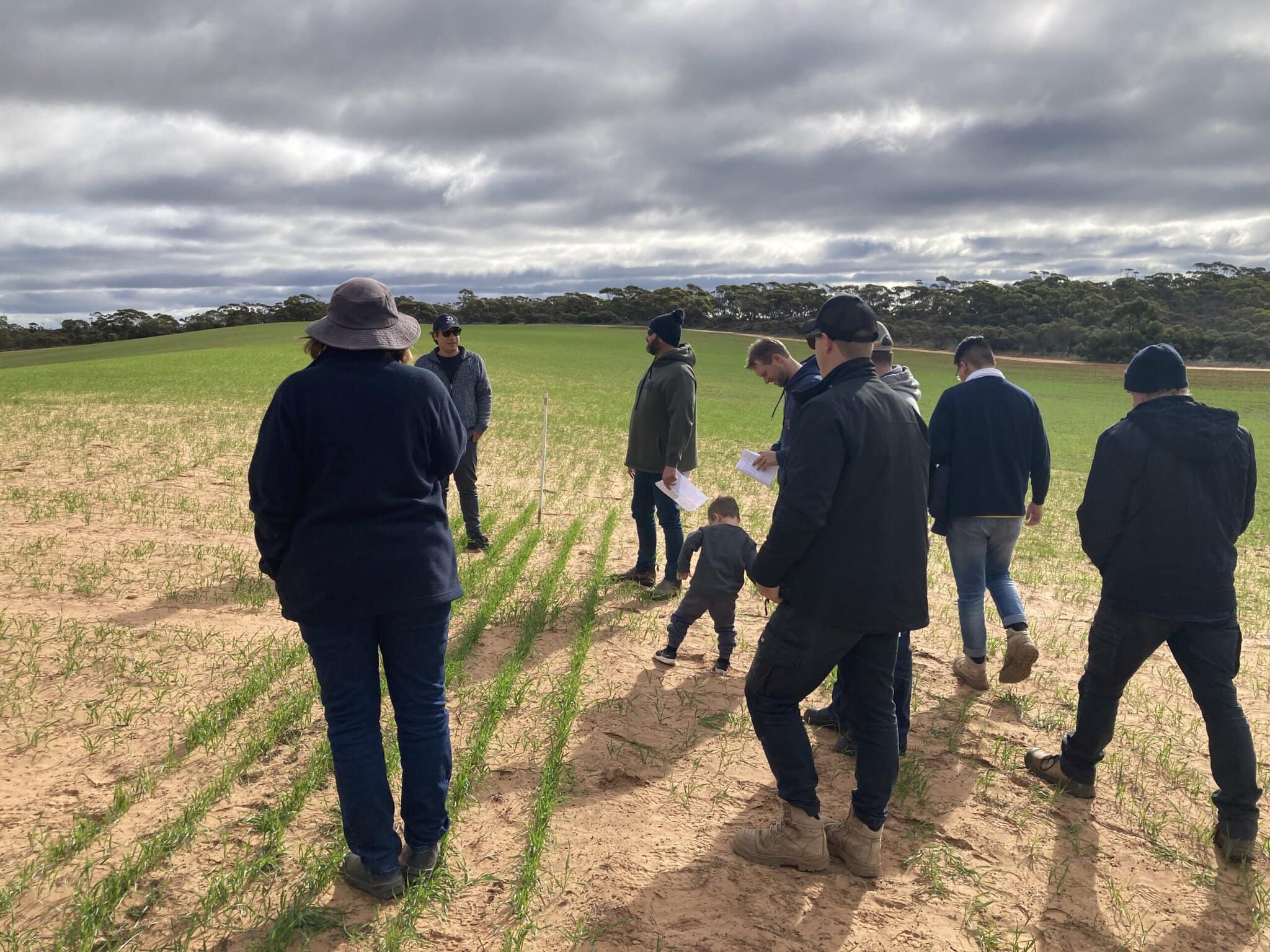
Small plot trial and larger scale farmer demonstrations north of Minnipa were harvested on 15 November 2023 for grain yield and quality assessment. In 2023, there were no differences in wheat grain yield with seeding position, seed priming or soil wetter compared to the control, with the trial averaging 0.86 t/ha. The 2023 growing season was a Decile 2 with a dry winter and dry spring, which limited grain fill. Grain protein, screenings, test weight and 1000-grain weight were not affected by seeding position, seed priming or soil wetter compared to the control.
SUMMARY OF FINDINGS
- Seeding into the soil moisture zone either shallow (2023) or deeper with a long coleoptile variety (2022 and 2023) can best maximise plant establishment and stubble groundcover in non-wetting sandy soil conditions.
- In 2022, deeper seeding improved wheat crop establishment and early/late development. While no grain yield benefits were detected in 2022, deeper sowing increased both protein content and grain size.
- Seed priming showed some potential to improve wheat seed germination under laboratory conditions, but it did not improve plant establishment under field conditions in 2022 and 2023.
- Soil wetter on a non-wetting sandy soil resulted in a small improvement in wheat crop establishment and early vigour in 2022.
The methods, results and discussion of trials and demonstrations conducted are described in the article: Developing robust groundcover to promote resilience in low rainfall mixed farms using seed priming. Eyre Peninsula Farming Systems Summary 2023.
Long coleoptile (EPAG Research)
This trial and the adjacent GRDC trial suggest that long coleoptile genetics can be used to aid crop emergence if sowing very deep to chase moisture. These results concur with those from Cootra in 2022 (EPFS Summary 2022, p. 92-94) which demonstrated that in years where surface soils are dry, but there is moisture at depth, cultivars with long coleoptile genetics were able to establish better from deeper sowing.
Results from Wharminda in 2023 also suggested that if there is soil moisture below the traditional seeding depth, current commercial varieties which are grown locally have the capacity to emerge from 6-8 cm with little establishment penalty. Whilst this has improved landholder confidence to sow to 8 cm, plant numbers at establishment were much lower when these varieties were sown deeper than that and growth penalties should be expected if targeting seeding that deep
SUMMARY OF FINDINGS
- Long coleoptile wheat can permit deep sowing to access soil moisture.
- When opportunities arise, it might be possible to use a range of currently available, shorter coleoptile, high yielding genetics sown deeper (6-8 cm) into moisture with only minor establishment and yield penalties.
- When sowing deep, good quality seed is important for emergence due to increased reliance on seed reserves and it is recommended that seed intended to be used for deep sowing has high germination and vigour, not affected by weather damage prior to harvest.
The methods, results and discussion of trials and demonstrations conducted are described in the article: Did long coleoptile wheat varieties have a role for developing robust ground cover on sandy soils at Wharminda in 2023? Eyre Peninsula Farming Systems Summary 2023.
This page was last updated on 31 October 2024.
Downloads:
Share this project:
You Might Also Like
Managing and Mitigating Dry Saline Soils (Magnesia Patches) in South Australia
AIR EP is leading an investment in demonstration and extension of identification, management and amelioration of dry saline land. AIR EP & partners will deliver a program of work to…
Improving phosphorus use efficiency and return on investment in high Phosphorus (P) fixing soils of the Southern and Western Regions
Aims to improve growers’ certainty about managing phosphorus (P) in high-fixing soils, which have chemical properties that bind applied P, making it unavailable to crops. The project outcome is that…
Stress Testing Regenerative Agricultural Practices – STRAP
Drought resilience in novel emerging dryland farming practices – A scientific and economic basis (Stress Testing Regenerative Agricultural Practices – STRAP) The project aims to rigorously study regenerative cropping and…
Innovative Soil Technologies: Fostering Resilience and Climate-Smart Crop Production in Australia
This project will apply recent advances in Innovative Soil Technologies (IST) to improve water capture and retention and water use efficiency. Through field trials conducted in SA, NSW, TAS, WA,…
Drought and climate resilient sheep farms and landscapes tailor-made for low rainfall farming regions
The profitability of sheep farming is declining due to the impacts of drought and extreme heat on pasture growth, soil stability and sheep performance. This project will enhance resilience of…
Climate-Ready Livestock: Building Resilient Farming Systems on Eyre Peninsula
Eyre Peninsula livestock producers are facing rapidly emerging challenges from climate change, including prolonged dry periods, declining water security, rising input costs, and increasing market pressures. This project will support…
Weed Management Initiative
This page was last updated on 6 January 2026. Delivery of one herbicide trial on EP for 2025-2029 (5 trial years) On an annual basis, establish, conduct, analyse and report…
Future Drought Fund Long Term Trials SA Discovery Farms – Sustainable phosphorous strategies for Eyre Peninsula
AIR EP has partnered with SA Discovery Farms, with co-investment by SAGIT, in a new project aimed at improving P fertiliser applications in variable paddocks/landscapes and refining long-term management strategies…
Young Farmer Peer to Peer Learning Lower EP 2025
AIR EP will establish a group comprised of Lower Eyre Peninsula young farmers (~18-35 years). This group will participate in three field events/workshops featuring speakers on topics that build agricultural,…
Building resilience – Break Crop Suitability Across Landscapes (Stage 2)
Upper North Farming Systems and AIR EP have worked to bring this common theme across the 3 farming groups and 4 Node regions together into the one project in 2024.…