
Retaining soil water in farming systems using strip & disc machinery 2024
This project has enabled one demonstration site to be conducted in 2024 in a low rainfall farming system at Buckleboo to enable extension of past EP demonstration site results and results from other regions, and to further investigate:
What are the measurable differences in stripper stubble vs conventional draper stubble sown using a disc seeding system in lentils? (e.g. plant growth, increased stored soil water in-season, weeds, pests, disease, yield, soil cover, nutrition).
Demonstration site information, prepared by Buddhi Chaudhary, SARDI Minnipa Agricultural Centre:
Site selection was undertaken on 1 May 2024 and soil sampling for soil water was taken after sowing on 20 May 2024. The previous 2023 trial site was sown and rolled by the grower prior to this project being funded, so a new trial site was selected and implemented for 2024 to demonstrate lentil growth in standing and rolled stripper stubble.
The site was sown by the landholder with Hallmark lentils on 3 May with 55 kg/ha of 15:13:11 (Granulock Z 15 S) fertiliser. Pre-sowing and post sowing pre-emergent (PSPE) herbicides were applied by the grower. Four soil core samples of each depth 0-10 cm, 10-30 cm, 30-60 cm and 60-90 cm were collected and combined into one composite sample to represent each depth for each strip. A subsample of each composite sample had been taken and dried to obtain the average moisture content of each depth (Figure 1). Figure 1 shows there are no differences in soil moisture down the soil profile (as expected) due to the stubble treatments only being implemented on 9 May 2024 when the project was funded.
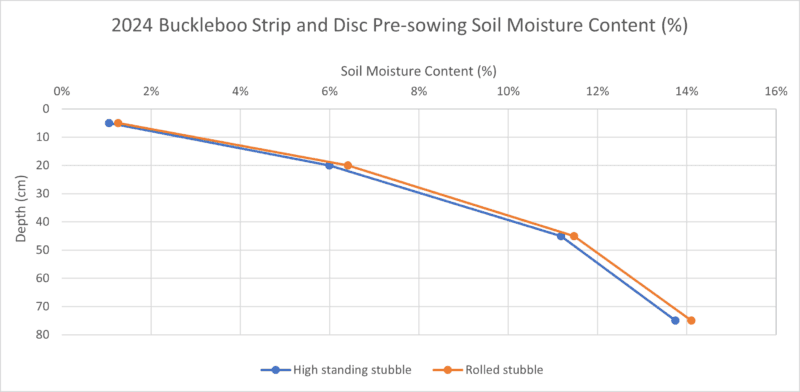
Figure 1. Average pre-sowing soil moisture content cross the soil profile (0-10 cm, 10-30 cm, 30-60 cm and 60-90 cm) from the high stubble and rolled stubble treatment plots implemented at Buckleboo 2024.
Stubble dry matter cut was conducted by measuring two 0.5m2 quadrat cuts in plots for soil cover assessment. The results of the average dry weight of the standing stubble (2.21 t/ha) was not significantly different to the rolled stubble treatments (1.58 t/ha).
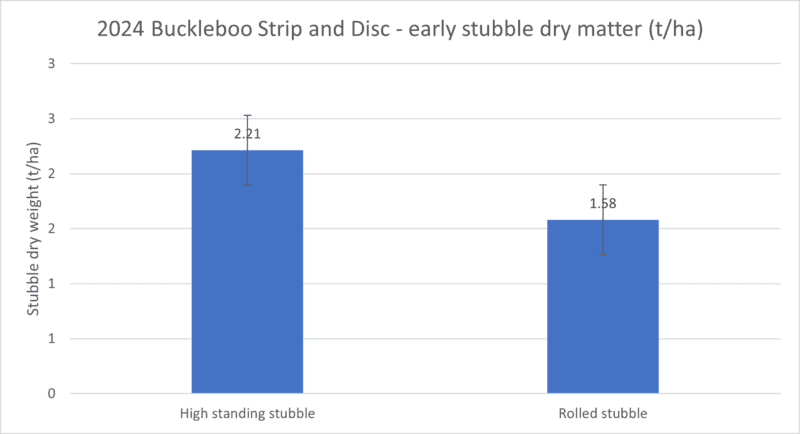
Figure 2. Average stubble weight (t/ha) from both high and low stubble treatments at the Buckleboo site 2024.
Plant establishment assessments were conducted on the 4 July 2024, when most of the lentils were at 2-3 node stage (Figure 3). The plant establishment count results did not show a significant difference in plant density with an average of 77.2 plants/m2 in high stubble strips and 77 plants/m2 in rolled stubble strips (Figure 4).
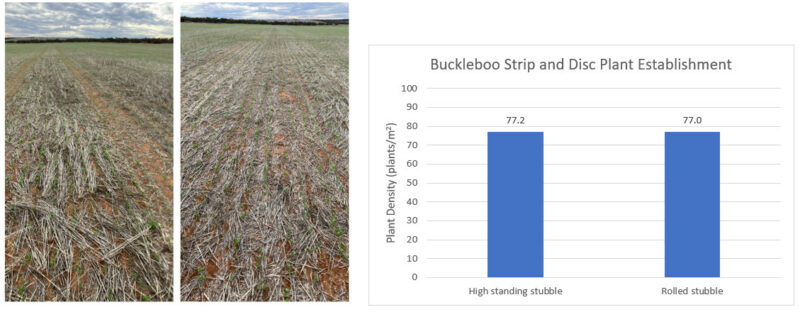
Figure 3. Lentils establishments in high stubble (left) and rolled stubble (right) treatment strips at Buckleboo 2024. Figure 4. The average density of established plants in both high and rolled stubble treatments at Buckleboo 2024.
Early-stage plant biomass (lentil dry matter) measurements were conducted on 17 July 2024 by harvesting 50 cm rows of sticks on both sides at two areas in the plot. The harvested sample was oven dried at 70°C for 48 hours for the dry matter measurements (Figure 5). There were no differences in early lentil biomass (0.17t/ha) due to the stubble treatments implemented.
Yield results to be added as they are processed and analysed.
This page was last updated on 18 November 2025.
Downloads:
Share this project:
You Might Also Like
Managing and Mitigating Dry Saline Soils (Magnesia Patches) in South Australia
AIR EP is leading an investment in demonstration and extension of identification, management and amelioration of dry saline land. AIR EP & partners will deliver a program of work to…
Improving phosphorus use efficiency and return on investment in high Phosphorus (P) fixing soils of the Southern and Western Regions
Aims to improve growers’ certainty about managing phosphorus (P) in high-fixing soils, which have chemical properties that bind applied P, making it unavailable to crops. The project outcome is that…
Stress Testing Regenerative Agricultural Practices – STRAP
Drought resilience in novel emerging dryland farming practices – A scientific and economic basis (Stress Testing Regenerative Agricultural Practices – STRAP) The project aims to rigorously study regenerative cropping and…
Innovative Soil Technologies: Fostering Resilience and Climate-Smart Crop Production in Australia
This project will apply recent advances in Innovative Soil Technologies (IST) to improve water capture and retention and water use efficiency. Through field trials conducted in SA, NSW, TAS, WA,…
Drought and climate resilient sheep farms and landscapes tailor-made for low rainfall farming regions
The profitability of sheep farming is declining due to the impacts of drought and extreme heat on pasture growth, soil stability and sheep performance. This project will enhance resilience of…
Climate-Ready Livestock: Building Resilient Farming Systems on Eyre Peninsula
Eyre Peninsula livestock producers are facing rapidly emerging challenges from climate change, including prolonged dry periods, declining water security, rising input costs, and increasing market pressures. This project will support…
Weed Management Initiative
This page was last updated on 6 January 2026. Delivery of one herbicide trial on EP for 2025-2029 (5 trial years) On an annual basis, establish, conduct, analyse and report…
Future Drought Fund Long Term Trials SA Discovery Farms – Sustainable phosphorous strategies for Eyre Peninsula
AIR EP has partnered with SA Discovery Farms, with co-investment by SAGIT, in a new project aimed at improving P fertiliser applications in variable paddocks/landscapes and refining long-term management strategies…
Young Farmer Peer to Peer Learning Lower EP 2025
AIR EP will establish a group comprised of Lower Eyre Peninsula young farmers (~18-35 years). This group will participate in three field events/workshops featuring speakers on topics that build agricultural,…
Building resilience – Break Crop Suitability Across Landscapes (Stage 2)
Upper North Farming Systems and AIR EP have worked to bring this common theme across the 3 farming groups and 4 Node regions together into the one project in 2024.…