Managing Herbicide Residues and Crop Choices for 2025: Lentils vs Cereals
The past 12 months have been among the driest on record for the Eyre Peninsula, creating a challenging backdrop for the 2025 cropping season. One emerging risk for growers is the potential impact of herbicide residues from 2024 applications. While it is important to meet label-specified plant-back periods, herbicide breakdown is influenced by many factors including rainfall frequency, soil type, and soil biological activity. The lack of follow-up rainfall means residues could still be present at levels that affect sensitive crops, including pulses.
In response, some growers have planted small test strips of their intended crops and watered them up to check for signs of herbicide damage. Early reports suggest that in some scenarios, while lentils are not dying from residual herbicides, they are showing clear symptoms of stress, appearing "sick" but surviving. This will vary depending on soil type and location, but for the sake of this article, we are discussing the scenario above.
This situation poses a difficult question: if lentils can survive but suffer some yield loss, are they still the better economic choice compared to switching to a second or third cereal crop?
To help answer this, a decision-support tool was developed with input from Barry Mudge and Peter Hayman. Using Kyancutta rainfall data and the French and Schultz yield prediction model (which relates yield potential to growing season rainfall), we estimated the probability of achieving different yields for wheat and lentils. These yields were then fed into the SAGIT gross margin calculator to estimate gross margins across rainfall deciles, factoring in the additional nitrogen input costs often needed for a second or third cereal crop.
To explore the impact of herbicide damage, we modelled a range of discounted lentil yields — for example, if herbicide residues reduced lentil yields to 80%, 60%, or 40% of their potential. This allows growers to see how different yield penalties affect gross margins and compare them to the returns from wheat.
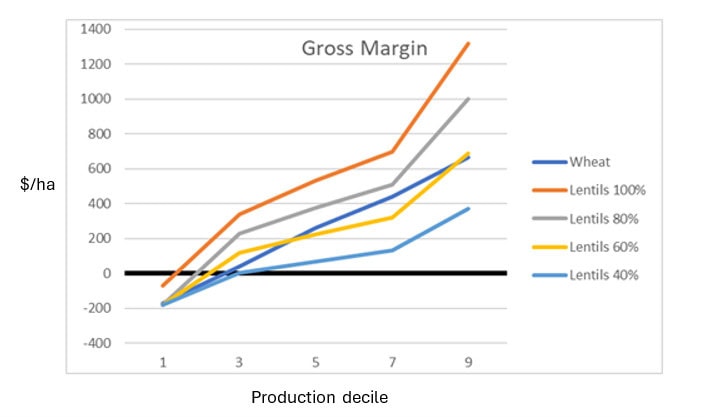
The results (see graph) show that even at reduced yields, lentils can still be competitive with cereals under certain conditions. However, as damage becomes more severe, the financial advantage of sticking with lentils diminishes, and cereals may become the safer choice.
It’s important to note that this analysis focuses purely on gross margins (at the moment, lentil gross margins are being driven by high prices). It does not account for the long-term rotational benefits of lentils, such as improved weed control, reduced cereal disease carryover, or nitrogen fixation for following crops — all important factors to consider in paddock planning.
Given the variability in herbicide breakdown and seasonal forecasts, growers are encouraged to assess paddock history carefully, continue field testing, and use decision tools like this to weigh the risks and rewards of different crop choices for 2025.
If you would like a copy of the gross margin spreadsheet or assistance in working through a specific paddock scenario, please get in touch.
Andrew Ware, EPAG Research