RiskWi$e: Yield Prophet prediction updates September 2025
Nitrogen Reflections as Yield Potential Shifts Across the Region
Prepared by Andrew Ware, EPAG Research
Seasonal Context – A Region in Flux
The 2025 season has shown just how variable yield expectations can be across Eyre Peninsula.
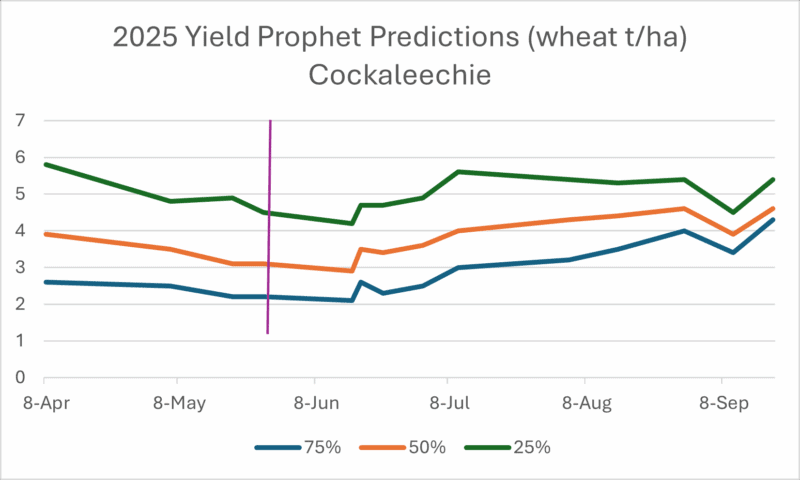
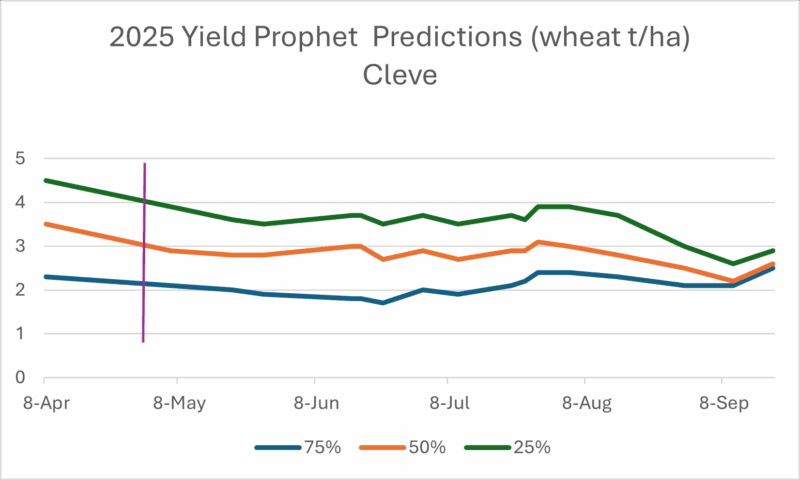
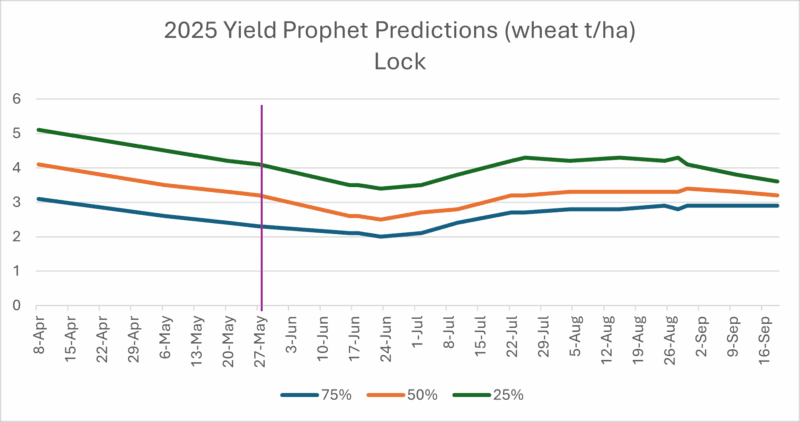
- Early Season: Yield Prophet® predictions began on the assumption of May establishment. In reality, the break didn’t come until early June, with crops emerging into some of the driest November–May soil moisture profiles on record.
- July Boost: Above-average July rainfall provided a lift in predicted yields across all monitored sites.
- August & September Decline: Since then, below-average August rainfall and rising September temperatures have pulled predictions back.
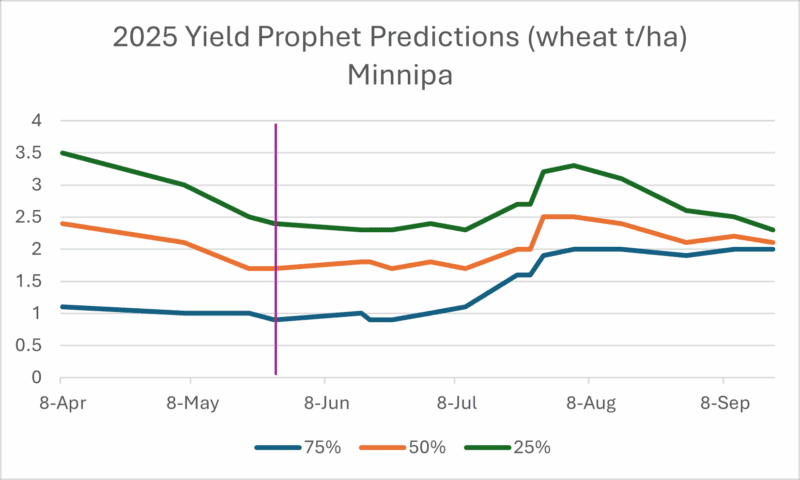
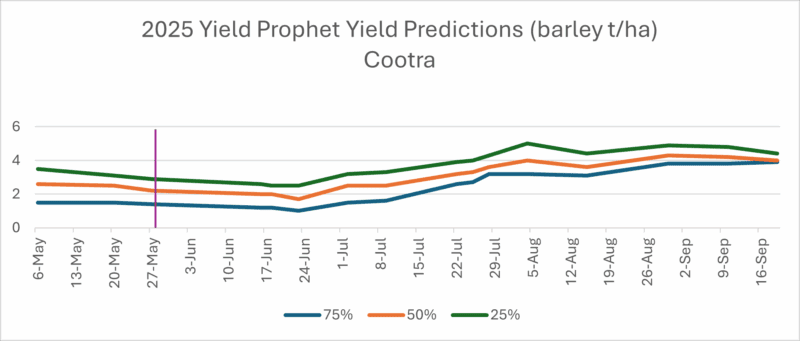
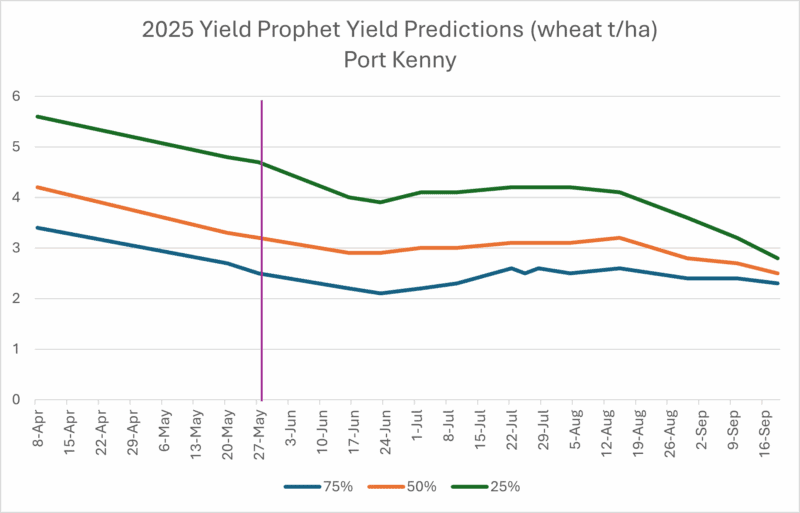
Across Port Kenny, Cockaleechie, Lock, Cleve, Cootra and Minnipa, the same pattern was observed: a dry start, a July lift, and a late-season slide. The scale varied by soil type and local rainfall, but the direction was consistent.
The graphs below show Yield Prophet outputs (yield predictions in t/ha) at different times during the growing season (starting before the season opening rains – purple vertical line). The three lines denote the differing probabilities that each of the yield prediction will eventuate. 75% = in 75% of years yields should equal or be greater than the blue line, 50% = in 50% of years yields should equal or be greater than the orange line, 25% = in 25% of years yields should equal or be greater than the green line.
N-Unlimited vs Heat & Frost Adjusted Yields
To look forward, Yield Prophet outputs for Edillilie, Wirrulla, and the other EP sites were run under two scenarios:
- N-Unlimited Potential – showing what crops might yield if nitrogen was never limiting.
- Heat & Frost Adjusted Potential – applying damage functions to capture likely losses from extreme temperatures as harvest approaches.
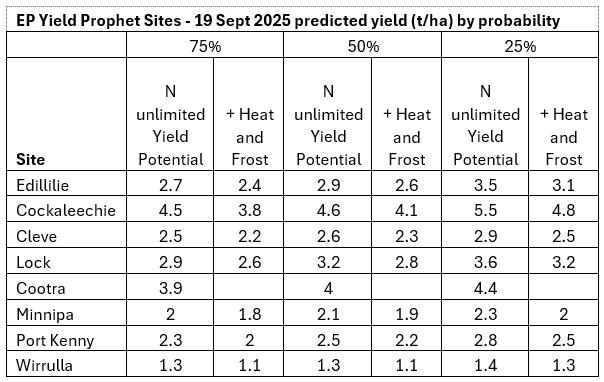
This comparison highlights that while nitrogen is often the first limiting factor, heat and frost risks loom large as spring advances. At several sites, N-unlimited yields looked promising in July, but the adjusted curves show how quickly weather risk can trim those expectations.
Nitrogen Management Learnings from 2025
- Know Your Starting Point
- Autumn soil testing in 2025 revealed many paddocks with <40 kg/ha N available.
- To reach even 2 t/ha wheat yields (40 kg N/t), those paddocks required ~88 kg/ha of urea just to break even.
- Without that baseline data, decisions relied on crop colour — a reactive, often too-late measure.
- Define a Realistic Target Yield
- For most EP businesses, early–mid July remains the critical decision point.
- By then, rainfall confidence and product access can guide realistic yield targets.
- These targets don’t need to match Yield Prophet’s upper curves — profitability often peaks below maximum potential.
- Focus on Profitability, Not Just Tonnes
- In deficiency, nitrogen usually pays: $1 of urea can return $3+ in grain value.
- Yet after several lean years, the temptation to “play safe” has been strong.
- The key is finding balance: overspending carries risk, but under-investing leaves grain — and profit — on the table.
Strategies to Refine Nitrogen Management in 2026
While 2025 has been a difficult season, it has also provided valuable insights that growers can carry forward. Some practical strategies include:
- Learn from This Year’s Soil and Crop Responses
- Observe which soil types and paddocks showed stronger signs of N deficiency — these are likely to be the highest-risk zones again in 2026.
- Review the performance of legume crops and pastures. Their contribution to soil N will influence how much fertiliser is needed in following cereals.
- Use these observations to guide targeted soil sampling ahead of 2026 sowing, rather than spreading sampling effort too thinly.
- Strengthen Logistics and Product Access
- Work through how much nitrogen product can realistically be stored on farm ahead of the season, to avoid in-season shortages.
- Assess spreading capacity: how quickly can N be applied when conditions change, and is additional contractor or machinery support needed?
- Consider whether variable-rate spreading is feasible on your farm. Matching N to soil type and yield potential reduces both under- and over-investment.
- Build Better Decision Tools
- Trial the use of N-rich strips or reference zones to help monitor crop responses through the season and refine in-season decision making.
- Continue to use tools like Yield Prophet alongside on-farm reference points to balance seasonal forecasts with paddock reality.
Take-Home Message
Across Eyre Peninsula in 2025, Yield Prophet outputs have told a consistent story:
- Shifting yield expectations driven by seasonal rainfall and temperature swings.
- Widespread N deficiency, especially where low soil reserves were not measured at sowing.
- Layered risks — with heat and frost now overlaying already tight nitrogen margins.
With harvest still ahead, now is a good time for growers and advisors to reflect on this year’s N strategy. The lessons of 2025 will be vital in setting up for 2026:
- Soil test baselines
- Clear, timely target setting
- Profit-focused investment decisions