Lentils on Eyre Peninsula: Profit, Risk and the Rotation Question
A crop that’s matured fast
Lentils have quickly become a mainstay in many Eyre Peninsula cropping systems. Once considered a high-risk, niche crop, their combination of strong historical prices, improving varietal adaptation, herbicide tolerance, and sound agronomy has made them one of the most profitable enterprises across much of the region.
But 2025 reminded growers that lentils are not without limits. A late seasonal break, unpredictable herbicide residues, a lot of wind and a dry spring reduced yield potential in many districts. Even so, many crops performed better than expected under the circumstances, confirming how far agronomy and variety improvement have come.
However, with grain prices predicted to fall below $600/t at harvest and input costs remaining elevated, questions are being asked:
How much of the program should lentils occupy in future years? Can they truly replace a medic pasture or livestock phase in the rotation?
Profit sensitivity: when yield and price meet soil type
Gross margin analysis shows just how exposed lentil profitability is to seasonal yield and price swings.
Table 1: Lentil gross margin sensitivity. Source SAGIT SA Gross Margin Guide 2025.
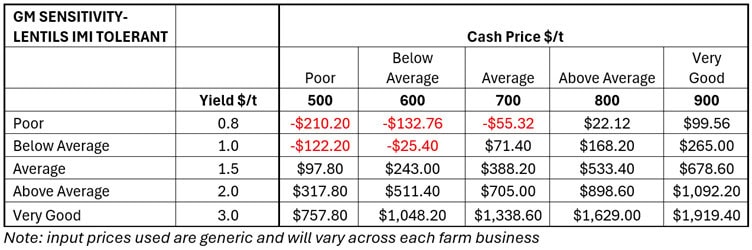
At $600/t, profitability remains strong where yields exceed 1.2 t/ha but quickly falls away on constrained or variable soils:
- On well-structured loams and heavier flats, yields of 1.5–2.0 t/ha still return gross margins competitive with wheat and well above canola.
- On calcareous, sandy, sodic, or saline soils, yields often dip below 1.0 t/ha in tough springs — and at current prices, gross margins can fall below zero.
- Wind and late establishment in 2025 exaggerated these differences, exposing just how yield-sensitive lentils are to soil constraints compared with cereals.
Another key limiting factor emerging in 2025 was soil acidity. Lentils appear more sensitive to low soil pH than wheat, barley, or canola. The adoption of soil pH mapping is helping growers identify problem areas, and lime application remains a relatively low-cost and effective remedy to restore productivity.
These results reinforce the need for careful paddock selection, realistic yield targets, and an honest assessment of the fit between price, soil and risk.
Grower perspectives: different paths to profit
We recently talked with a cross-section of seven Eyre Peninsula growers about how their rotational strategy going into 2026 is being formed:
“Every grower has to be realistic about what each land class can do.”
Several growers without livestock noted they now see lentils as one of a suite of tactical options — not a universal solution. Canola or cereals may outperform lentils on poorer or frost-prone soils, particularly where stored soil moisture allows an early sowing opportunity.
“At $600/t, one tonne of lentils still equals two tonnes of wheat.”
Some argued that lentils remain a solid break crop even at lower prices, given their nitrogen and water-saving legacy compared to canola. But they warned that those “in and out” of lentils tend to lose money; consistency in management, variety and paddock choice pays.
“We need a legume — peas get frosted, beans don’t yield — so we grow lentils.”
For some central and upper EP growers, lentils remain the only viable broadleaf legume option, provided herbicide residues are managed and soils are not too sandy.
“Sheep add flexibility when the break is late or rainfall uncertain.”
Growers maintaining livestock valued the ability to pivot late in the season if conditions weren’t right for lentils. On mixed farms, lentils are often treated as an opportunistic crop rather than a guaranteed one.
“Don’t go chasing rainbows.”
Several advisors emphasised that chasing short-term price trends risks destabilising the long-term rotation. A balanced, well-planned rotation remains the foundation for whole-farm profitability.
Rotation rethink: lentils or livestock?
The 2025 season reminded growers that while lentils are now a proven profit driver on the right soils, they’re still a fragile option on constrained country. For many farms, sheep remain the simplest and most reliable way to extract value from the less productive portions of the landscape and to manage rotational and financial risk.
The opportunity for 2026 and beyond isn’t about choosing lentils or livestock—it’s about matching enterprises to capability. On well-structured, herbicide-clean loams, lentils will continue to out-perform. But on sandy, sodic or variable soils, maintaining a modest sheep flock or investigating alternative land use options may deliver stronger whole-farm stability than chasing marginal lentil paddocks.
The 2025 season underscored both the resilience and the fragility of lentils. While crops performed better than many expected in a difficult year, the season also revealed weaknesses in yield potential that lack clear solutions. However, new techniques such as on-row sowing are showing strong promise in helping overcome some of the inherent soil constraints limiting performance.
Author: Andrew Ware, EPAG Research
Acknowledgements: Thanks to Jacob Giles, local growers and advisors who contributed their insights to this article.
Data sources: EPAG Research, GRDC RiskWi$e project, 2025 SAGIT Gross Margin Sensitivity analysis, Eyre Peninsula grower interviews.
Projects: This work has been funded by the GRDC Legume Extension project, in conjunction with the GRDC RiskWi$e project.