
From Constraint to Potential: EP Sandy Soils Case Studies
Sandy soils have long limited production across the Eyre Peninsula. Through the Building drought resilience by scaling out farming practices that enhance the productive capacity of sandy soil landscapes project, AIR EP and delivery partners collaborated with growers to evaluate practical amelioration strategies under paddock conditions.
The demonstrations at Kyancutta, Poochera and Streaky Bay investigated ripping, soil mixing and nutrition strategies to address common sandy soil constraints including:
- Water repellence
- High soil strength layers (naturally occurring or compacted)
- Low organic carbon and fertility
- Low plant available water
- Nutrient tie-up (particularly on calcareous sands)
The findings from these EP trials closely aligned with principles outlined in the GRDC publication Sandy Soils of the Southern Region (2024), which highlights that sandy soils often suffer from multiple interacting constraints and require targeted, sites and soil-specific management.
Here is what the results from the EP demonstrations indicated.
Kyancutta – Depth of Constraint Dictated Depth of Response
Brett O’Brien | ~1,000 ha sandy soils (25% of farm)
(Source: Case Study 6)
At Kyancutta, sand hills historically yielded up to 50% less than surrounding soils. The trial compared four machines across two soil types — siliceous and calcareous sands. Soil penetration resistance measurements (taken in December 2023) indicated a layer of moderately high soil strength (~1800 to 2000 kPa) from 15-35 cm below the soil surface. In the siliceous sands there was a much narrower band of higher strength soil (5 cm band from 20-25 cm below the soil surface).
On calcareous sand:
- All machines reduced compaction to their working depth.
- Where the whole depth of the compaction constraint was addressed by deeper soil loosening, crop yields were highest.
- Delver + spader (500 mm depth) increased yield by 1 t/ha.
On siliceous sand:
- Responses were smaller and less consistent.
- All amelioration treatments addressed the shallow compaction layer but had higher soil strength at depth.
- The Plozza plough (200 mm depth) delivered the strongest response (+0.5 t/ha).
- Some deeper treatments did not outperform the control; this might indicate that soil strength was not the biggest constraint to production on the siliceous sand at this site.
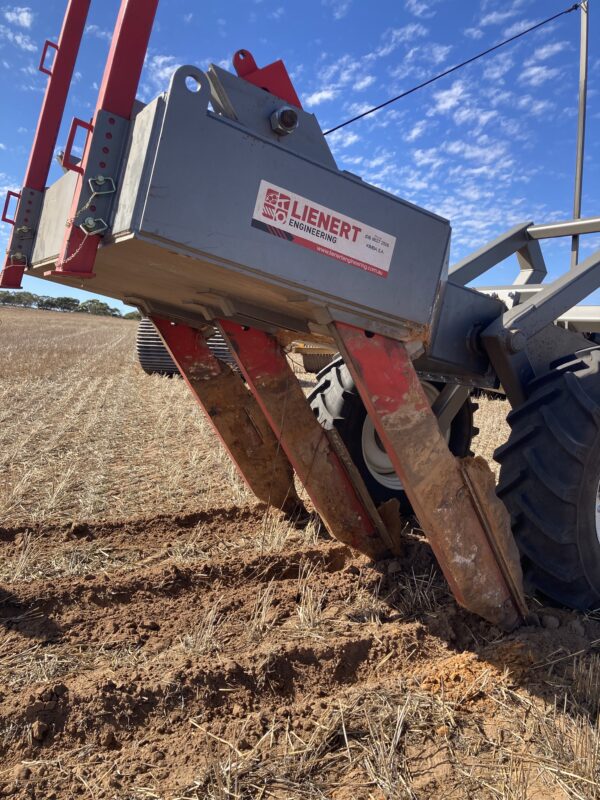
The Lienert 3 tine delver in action at the when the demonstration was established.
The GRDC publication notes that calcareous sands often contain deeper compaction layers, and subsoil constraints that restrict root growth and water extraction. It also highlights that alleviating compaction below 300 mm can improve access to stored subsoil moisture — particularly in seasons with dry finishes.
However, GRDC also cautions that greater biomass does not always translate into grain yield when spring moisture is limited — a pattern observed at Kyancutta.
Matching disturbance depth to the actual constraint depth was critical. Soil type strongly influenced return on investment.
Poochera – Strong First-Year Gains from Removing Physical Constraints
Wes Daniell | 200 ha sandy soils
(Source: Case Study 10)
At Poochera, white siliceous sands over poorly structured clay were constrained by compaction, low fertility and limited water holding capacity. In a poor year it was not unusual for the sandy soils to yield 25% less than other soil types and up to 50% in a good year.
A deep ripping strip established in 2022 delivered:
- +80% biomass
- +20% grain yield (3.8 t/ha vs 3.2 t/ha)
GRDC research explains this response clearly: sandy soils often have penetration resistance exceeding 2,500 kPa — the threshold at which root growth becomes restricted. Alleviating this constraint can rapidly improve early root exploration and crop vigour.
However, the following year (medic pasture), the yield response was less pronounced. Penetrometer readings suggested reconsolidation may have occurred.
Things to consider:
The longevity of improved production responses from deep ripping may vary from site to site depending on sand mineralogy and the presence of clayey subsurface materials.
Careful identification of constraints and application of treatments is required to maximise the benefit and longevity of treatments.
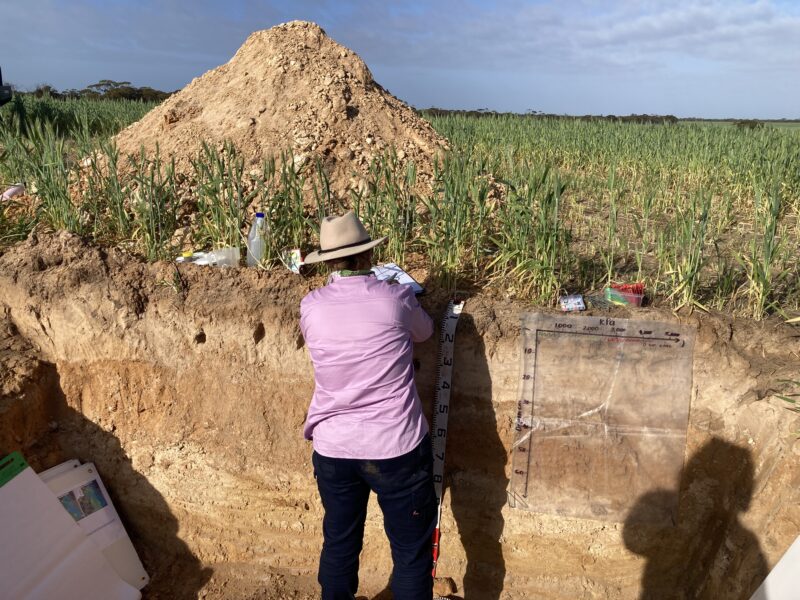
Dr Melissa Fraser from Soil Function Consulting, in a soil pit at the demonstration site in 2023.
Streaky Bay – When Soil Chemistry Limits Response
Dion Williams | 500 ha sandy soils (10–15%)
(Source: Case Study 7)
At Streaky Bay, highly calcareous grey sands presented with water repellence and low fertility. The trial compared ripping, manure, mineral fertiliser, and companion planting. The years in which the trial was monitored (2022 and 2023) had good seasonal conditions with average to above average crop and pasture growth.
Results:
- There were no significant improvements in pasture growth or crop yield from applied treatments during the years the trial was monitored.
- Ripping at this site had no yield benefit.
- Mineral fertiliser performed similarly to manure.
The GRDC sandy soils guide emphasises that calcareous sands often suffer from:
- Phosphorus tie-up
- Micronutrient deficiencies
- Low nutrient buffering capacity
- High variability
It also notes that in above-average seasons, soil constraints may not be the primary yield-limiting factor. On calcareous soils, nutrient chemistry may be a bigger constraint than compaction. This trial reflects this with two wetter seasons experienced in the trial years with no significant treatment responses measured. This trial also highlighted that not all sandy soil sites respond to ripping, and reflected the poor response seen from ripping other calcareous sands.
What did we learn from the EP sites?
Where constraints were correctly identified and treated, sandy soils showed strong economic potential. However, where the primary limitation was not compaction, ripping alone delivered little benefit and so it is important to recognise:
- Sandy soils are rarely limited by one issue alone
Compaction, water repellence, low fertility, and poor water holding capacity often interact and it is important to effectively diagnose what constraints are present, at what depth in the soil layer and their severity in order to develop an appropriate management strategy.
- Soil type dictates response
Calcareous sands and siliceous sands behave differently and the response from treatments will be influenced by landscape features such as clay type and percentage, depth to clay or carbonate and clay type, conditions at the time of treatment implementation and crop type.
- Depth of disturbance must match depth of constraint
Working too shallow leaves yield potential untapped. Working deeper than needed adds cost without return.
- Nutrition must follow amelioration
GRDC clearly states that once physical constraints are removed, nutrient demand increases. Failing to meet nutrition demands will results in yield penalties.
- Seasonal finish influences economic outcome
Dry springs can limit grain fill even when biomass improves.
It is crucial to diagnose before you disturb.
Before investing in amelioration:
- Understand what type of sandy soil you are dealing i.e. deep calcareous or siliceous sand, duplex sand over clay.
- Check for surface water repellence in the field using the water droplet penetration test.
- Measure penetration resistance to identify compaction depth. For accurate diagnosis this measurement should be undertaken when the soil profile is damp but not saturated (at field capacity).
- Assess pH, depth to clay and depth to carbonate (hard or soft) within the soil profile (ideally to 1 m but to at least below the working depth of the intended amelioration machinery).
- Assess soil nutrition status and budget for increased fertiliser demand post-treatment. Often large yield benefits are seen in the first year following soil amelioration as improved root growth allow crops to access unused soil moisture and nutrients from deep soil layers. Thought must be given to supplying sufficient nutrition to meet improved yield potentials.
- Plan for erosion management immediately after disturbance.
More information
The full suite of case studies and resources can be found here https://bit.ly/46Yi2ed
Acknowledgements
Prepared by Brett Masters, EPAG Research and Amy Wright, AIR EP.
The Sustainable Agriculture project is supported by the Australian Government through funding from the Natural Heritage Trust under the Climate-Smart Agriculture Program and delivered for the Eyre Peninsula Landscape Board, a member of the Commonwealth Regional Delivery Partners panel by AIR EP and EPAG Research.
The project Building drought resilience by scaling out farming practices that enhance the productive capacity of sandy soil landscapes was funded by the Australian Government’s Future Drought Fund.
