Fertiliser decisions under pressure – What changes when price & supply bite?
Recent discussions across the region, supported by farmer experience and limited analysis of nitrogen response and return-on-investment (ROI) scenarios, highlight a key issue: many fertiliser decisions are made with limited on-farm evidence of profitability. This glaring gap is now more apparent than ever.
This article draws on local observations, project insights, and scenario modelling to prompt a practical question:
“How confident are you in your fertiliser decisions when conditions change?”
When pressure hits, decisions get harder
This season, higher prices and supply uncertainty are forcing a rethink. For many farmers, the immediate focus has been simply securing product. But as the season unfolds, attention will inevitably shift toward how fertiliser use itself should change.
Without strong farm-specific data, decisions are being pieced together from a mix of observation, soil tests, grain prices and general rules of thumb. It’s a practical approach—but confidence in those decisions varies widely between businesses.
What the nitrogen scenarios are telling us
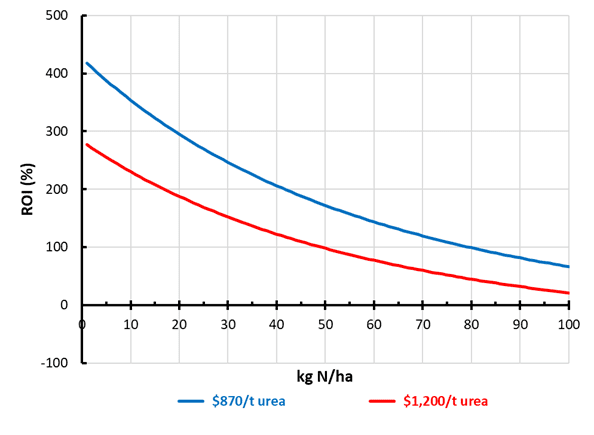
The nitrogen response and ROI scenarios (see graphs) highlight a trade-off that’s becoming very real this year.
As urea prices increase, the nitrogen rate required to achieve a target return on investment drops—but so does yield.
For example, using what could be considered a “typical” response to nitrogen, to achieve 100% ROI on nitrogen:
- About 80 kg N/ha may be appropriate at ~$870/t urea
- About 50 kg N/ha may be appropriate at ~$1,200/t urea
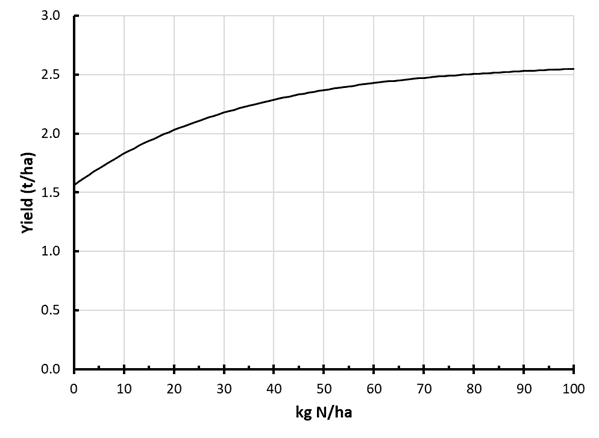
That reduction in N rate comes with an estimated yield penalty of around 0.14 t/ha, or roughly $45/ha in lost income.
So the decision isn’t just about fertiliser efficiency—it’s about overall business performance.
Some farmers may choose to pull back rates to protect ROI on nitrogen. Others may keep rates higher, accept a lower ROI on nitrogen, and aim to maintain production. Both approaches are valid depending on the business. This is where having good understanding of both the technical and financial aspects of input use within the overall context of the farm business is so important – all the time.
Phosphorus and starter fertiliser considerations
Starter P rates are often adjusted in response to fertiliser pricing. However, recent research across the Eyre Peninsula, Mid North and Yorke Peninsula shows that while some soil types are unlikely to respond to P, others—particularly calcareous soils—are responsive, and reducing P rates in these situations is likely to result in yield loss.
This again highlights the value of on-farm experimentation to determine where opportunities to improve P strategy may lie.
Where the real risk sits: in-season nitrogen
The bigger exposure this year is likely to be in-season nitrogen.
Reliance on urea, combined with price volatility and supply uncertainty, means farmers may have less flexibility than usual.
This places greater importance on timing, confidence, and having a clear strategy before the season unfolds.
The farmers in the strongest position right now
One clear takeaway from across the region is that farmers who have invested time in measuring fertiliser response are in a stronger position.
They are still making decisions under uncertainty, but with far less guesswork. They have a clearer understanding of where fertiliser delivers value on their soils and within their system, allowing for more deliberate decisions.
For others, this season may highlight the value of starting to build that dataset for the future.
Key messages
- Fertiliser decisions are often habit-based rather than data-driven
- Price and supply pressure highlight gaps in decision confidence
- Reducing fertiliser rates can improve ROI, but may impact whole-farm profit
- Nitrogen decisions carry the greatest financial risk this season
- Farmers with their own trial data are better equipped to adapt
- There is no one-size-fits-all answer—every business will respond differently
Discussion prompts for your business
Rather than looking for a single “right” answer, this season is an opportunity to ask a few key questions:
- How much of your fertiliser program is based on evidence versus habit?
- Where could you safely adjust inputs without affecting profit?
- Are you aiming to maximise ROI on fertiliser, or overall farm income?
- What level of risk are you comfortable carrying with in-season nitrogen?
Next steps for farmers
- Set up a few simple strip trials to test N rates
- Monitor and measure yield and protein outcomes, not just crop appearance
- Review fertiliser decisions in the context of whole-farm profitability
- Engage with current extension opportunities
👉 For more information, register for the GRDC “Spreading your fertiliser budget further” webinar being held on 1 April, to provide timely insights and discussion.
Acknowledgements
This discussion draws on farmer observations, project insights, and scenario analysis relevant to Eyre Peninsula farming systems. We thank contributing farmers, advisors, and analysts for sharing their experience and perspectives.