RiskWi$e EP: A reasonable start… but still some tricky decisions ahead
This is part 1 of a 3 part series prepared by Andrew Ware for the EP RiskWi$e project.
There’s a fair bit going on across the Eyre Peninsula heading into seeding this year.
After a run of tight seasons, most businesses are carrying a bit of fatigue. Margins have been thin, or negative in some cases. Costs have crept up. And there’s still a fair bit of uncertainty around input supply—particularly fertiliser.
At the same time, this season hasn’t started badly.
Many areas picked up useful rainfall through March. There’s moisture in the seedbed in a lot of paddocks. For some, that’s created an opportunity to get crops in the ground earlier than we’ve been able to in recent years.
So we’re starting with two things that don’t always sit comfortably together:
- there’s some early opportunity
- but there’s also a fair bit of risk around how the season plays out
That’s making decisions feel harder than usual.
The start of the season looks better than the last few
One of the clearer positives is soil moisture.
From the paddocks we’ve been measuring, plant available water going into the season is generally higher than what we’ve seen over the past couple of years. It’s not exceptional everywhere, but it’s enough to shift yield potential upwards.
Using simple water-limited yield calculations, a number of situations are currently pointing towards:
- ~3 t/ha potential under an average finish
- ~2–2.7 t/ha under a drier finish
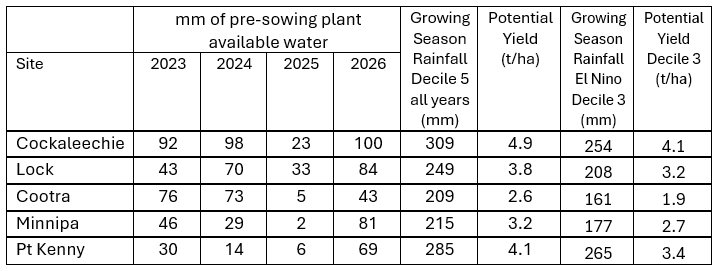
That’s not a guarantee—but it does suggest this isn’t a season where we should assume there’s no upside. Stored moisture is doing a lot of the work here, particularly on better soils with higher water holding capacity.
Sowing opportunity is there — but it may not last
The current conditions are creating a familiar tension.
There is moisture in the seedbed, but a warm, dry period is forecast. That raises the question:
- do you take the opportunity now, or wait for a more reliable break?
A number of growers have already started:
- lentils are going in
- canola is going in where moisture is close to the surface
That’s understandable—but it does come with risk.
Canola in particular is more exposed:
- shallower sowing depth
- greater sensitivity to drying of the seedbed
- higher reliance on follow-up rainfall
So while the opportunity is real, it’s not without consequences if conditions tighten quickly.
Early sowing can shift risk, not remove it
One of the useful reminders this year is around flowering timing.
Using a Mace-type wheat at Minnipa as a guide:
- sowing around mid-April pushes flowering into mid-July
- late April → early August
- early May → mid-August
- mid-May → late August
That shift happens quickly.
While moisture might suggest “go early”, phenology is saying:
- early sowing can increase exposure to flowering too rapidly, not accumulating enough biomass to turn into grain and a higher frost risk.
That doesn’t mean early sowing is wrong. But it does mean it needs to be deliberate—matching crop and variety to the level of risk you’re prepared to carry.
There’s probably enough nitrogen for 2 t/ha
The general read across many paddocks that have been sampled for soil nitrogen is that despite there is a large amount of variability across and between paddocks:
- many situations have enough N in the system for around 2 t/ha
- but pushing beyond that will likely require additional fertiliser
That’s where things become more complicated this year.
- urea prices are high
- supply is uncertain
- and the seasonal outlook is not clear-cut
So the question isn’t just:
“How much nitrogen do I need?”
It’s:
“How confident am I that I’ll get a return on that nitrogen?”
The seasonal outlook is adding another layer
There’s been a lot of discussion about a potential El Niño developing.
The important point is:
- it increases the likelihood of a drier finish
- but it doesn’t guarantee it
In practical terms, it shifts the odds:
- the chance of a drier season becomes more likely
- but good seasons are still possible
That makes it harder to commit strongly one way or the other.
This is a year for targeted and well-planned decisions
Putting all of that together, this season doesn’t lend itself to simple decisions.
- Moisture suggests there is opportunity
- Phenology suggests some caution on timing
- Stored water suggests yield potential is reasonable
- Input prices suggest restraint
- Seasonal outlook suggests managing downside risk
That’s why a planned approach considering a number of outcomes that can evolve as the season develops is likely to be more robust than trying to get everything “right” up front.
For many businesses, that might look like:
- taking sowing opportunities where they make sense
- being deliberate about crop and variety choice
- avoiding over-committing to high yield potential too early
- keeping flexibility around in-season nitrogen where possible
There are reasons to be cautious this year. But it’s probably not as simple as “good season” or “bad season”. There is genuine upside—but it sits alongside real downside risk. The challenge is not picking which one will happen. It’s making decisions now that still make sense if the season turns out either way.