
New project tackling dry saline soils across SA cropping regions
Dry saline soils — often called magnesia patches — are a frustrating and growing issue for many farmers across South Australia.
These are the bare or patchy areas in paddocks where crops struggle to establish, grow poorly, or fail altogether. They are not the same as Mallee seeps or watertable-related salinity. In dry saline patches, salts can move up from the subsoil during hot, dry conditions and build up near the surface. Once the surface becomes bare, the problem can get worse, as there is less plant cover to protect the soil and reduce evaporation.
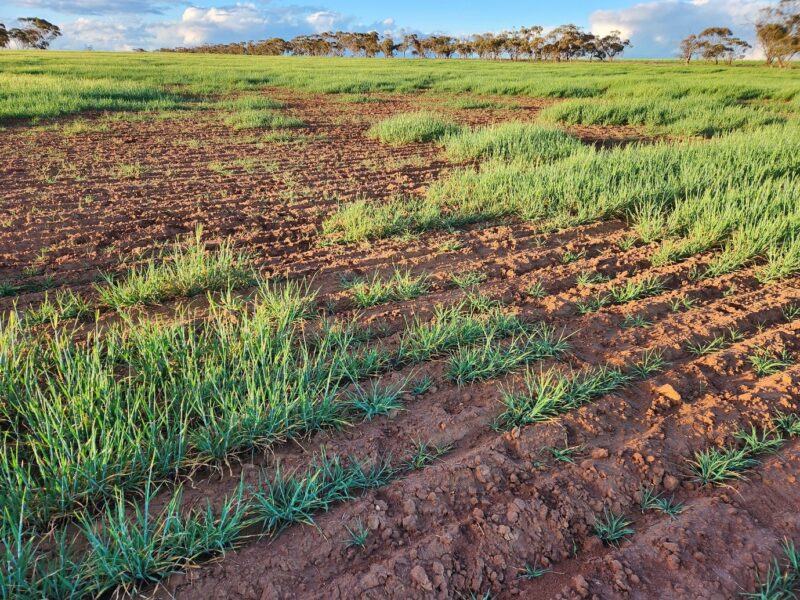
A new GRDC-funded project titled NGN Managing and Mitigating Dry Saline Soils (Magnesia Patches) in South Australia, is now underway to better understand the size of the issue and test practical ways to manage it.
The project is led by AIR EP in collaboration with the Northern and Yorke Landscape Board, Eyre Peninsula Landscape Board, Upper North Farming Systems, SARDI, Mallee Sustainable Farming, Agronomy Solutions and Insight Extension for Agriculture.
The project will run across the 2026, 2027 and 2028 growing seasons, with a focus on identifying practical, paddock scale management options.
Why this work is needed
Previous survey work undertaken in 2020 showed that dry saline land was already a significant issue across parts of the Murray Mallee and Eyre Peninsula. That work estimated around 50,000 hectares were affected across those regions, with an estimated cost of about $50 million over the previous 10 years.
Since then, many farmers have continued to report patchy establishment, bare scalded areas, reduced crop performance and uncertainty about what to do next. This new project will help update the cost of dry saline soils to farmers bottom line, understand whether the problem is changing, and test which management options are most useful in different situations.
What will the project do?
The project has three main parts.
The first is to better understand how widespread dry saline soils are across South Australian cropping regions, and what they are costing farm businesses in lost production, wasted inputs and management costs.
The second is to establish and monitor demonstration sites where different management options can be tested under local conditions.
The third is to share what is learnt with farmers and advisers through crop walks, articles, case studies, discussion groups and other extension activities.
The aim is not to come up with a single “silver bullet”. Dry saline soils behave differently across soil types, seasons and farming systems. What works on one patch may not work on another. This project is about testing a range of practical options and working out where they fit.
Importantly, the project will not only look at whether treatments improve crop growth. It will also consider cost, practicality and return on investment, so farmers can weigh up whether an option is likely to stack up in their own system.
Demonstration sites in 2026
Five demonstration sites are being established across the Upper Eyre Peninsula and Mid/Upper North regions in 2026.
Planned sites include areas near Kimba, Minnipa, Balaklava, Eudunda/Robertstown and Wandearah. Treatments vary between sites, depending on the soil type, the severity of the patches, what the farmer is able to implement, and what makes sense for that farming system.
Treatments being trialled include:
- spreading sand or mineral mulch over affected areas
- applying straw, compost or other organic matter to improve soil cover
- sowing early after rainfall, when salts may have been pushed deeper into the soil profile
- sowing on-row to target less salty zones
- comparing more salt-tolerant crop types or varieties
- keeping groundcover on affected areas over summer
One of the key ideas being tested is the value of keeping the soil covered. Bare ground allows more evaporation, which can draw salty moisture back to the surface. Maintaining cover — whether from crop, stubble, straw, chaff or another source — may help reduce salt build-up and improve the chances of crop establishment.
The sites will be monitored over several seasons so the project can assess not only first-year responses, but also how long treatments last, how they perform in different seasons, and whether they are economically viable.
Measurements will include things like crop establishment, plant vigour, groundcover, soil salinity, biomass and yield where possible.
Just a quick note on the season so far and what we are observing at some of the sites: crop establishment has been good in the typically poor areas (sometimes better than the ‘good’ areas of the paddock) due to timely rain that has washed salinity down the profile a bit/diluted the salinity and also possibly having greater access to nutrition that has been left behind in poorer seasons. We are checking this out to verify what’s going on here.
Keep an eye out for crop walks
Farmers and advisers will have opportunities to see the sites as the project gets underway.
Crop walks and local updates will be organised through participating grower groups and project partners. These will provide an opportunity to look at the treatments in the paddock, talk through what is working or not working, and share farmer experiences.
For local updates, contact Naomi Scholz, 0428 540 670.
Have your say: Dry saline soils survey
A key part of the project is a grower survey on dry saline soils.
The survey will help build a clearer picture of:
- how much land is affected
- how the problem has changed over time
- what it is costing farmers in lost income and wasted inputs
- what farmers have already tried
- which management options look most promising
- where further research and extension should focus
This survey builds on earlier work completed in 2020 and will help show whether the issue has changed since then.
The survey is aimed at farmers who have dry saline or magnesia patches on their farms, but responses are also useful from farmers who are unsure, only have small areas, or are just starting to notice patchy establishment.
This survey is about dry saline or magnesia patches — not Mallee seeps or watertable-related salinity.
The survey will take around 10–15 minutes to complete. Responses will be reported in a de-identified way, and the results will help guide future GRDC investment, trial work and extension activities.
The survey is expected to be open during June and July, closing Friday 17 July 2026.
Survey link: Dry Saline Soils (Magnesia Patches) – Grower Survey 2026 – Fill in form
If you would prefer to complete the survey over the phone, contact Naomi Scholz on 0428 540 670 and I can record your responses.
Why farmer input matters
Farmer experience is central to this project.
Many farmers have already tried things like sand, straw, hay, gypsum, different sowing tactics, different crop types or simply avoiding the worst areas. Some approaches have shown promise, while others have been too costly, too hard to implement, or too unreliable.
By sharing what has happened on your own farm — even if it has not worked — you can help build a more useful picture for the whole industry.
The more farmers who complete the survey, the stronger the final report will be.
Get involved
Farmers can get involved by:
- completing the dry saline soils survey when it is released
- keeping an eye out for local crop walks and site visits
- sharing experiences of what they have tried on affected areas
- talking to local project partners if they are interested in trial or demonstration work
For more information, contact Naomi Scholz, 0428 540 670 at AIR EP.
Project acknowledgement
The NGN Managing and Mitigating Dry Saline Soils (Magnesia Patches) in South Australia, project code AIP2602-001RTX is funded by GRDC and led by AIR EP in collaboration with Northern and Yorke Landscape Board, Eyre Peninsula Landscape Board, Upper North Farming Systems, South Australian Research & Development Institute, Mallee Sustainable Farming, Agronomy Solutions and Insight Extension for Agriculture.
