
2026 Crop Establishment – A vast contrast to 2025
By Brett Masters, EPAG Research
A timely break to the season has given 2026 crops one of the best starts on record, with opening rains allowing seeding to begin across most parts of the Eyre Peninsula as early as April. It’s a far cry from the previous 2 years where much of crop was either sown deep into marginal soil moisture, or sown dry and left waiting until late May/early June for opening rains.
In contrast, crops this season were either sown into wet, damp soil profiles or received a germinating rain relatively close to the sowing date. In fact early crops were already at late tillering stage by mid-May, with later sown crops starting to emerge.
As part of the Eyre Peninsula Landscape Board ‘Sustainable Agriculture’ program, crop establishment was monitored in May and early June at several sites across lower and central EP. At each site, sandy textured surface soils regularly hindered crop emergence, early crop vigour and the growth of early surface cover to protect the soil against the risk of erosion.
Target plant numbers at establishment on Eyre Peninsula range from:
- 120-150 plants/m2 for cereals
- 30-50 plants/m2 for canola
- 90-120 plants/m2 for lentils
- Approximately 20-30 plants/m2 for larger pulse grains such as faba beans, field peas and lupins
Crop establishment field surveys were conducted on 4 sites, each with a different crop type, where some form of amelioration had been undertaken to address production constraints on sandy soils including water repellence and layers of high soil strength. Soil profiles at Mount Hope, Brimpton Lake and Wharminda had texture contrasts of sand over clay. The Kyancutta site had a gradational siliceous sandy profile and a gradational calcareous sandy profile, the amelioration treatments at this site were applied across both soil types.
Site Location and Treatments
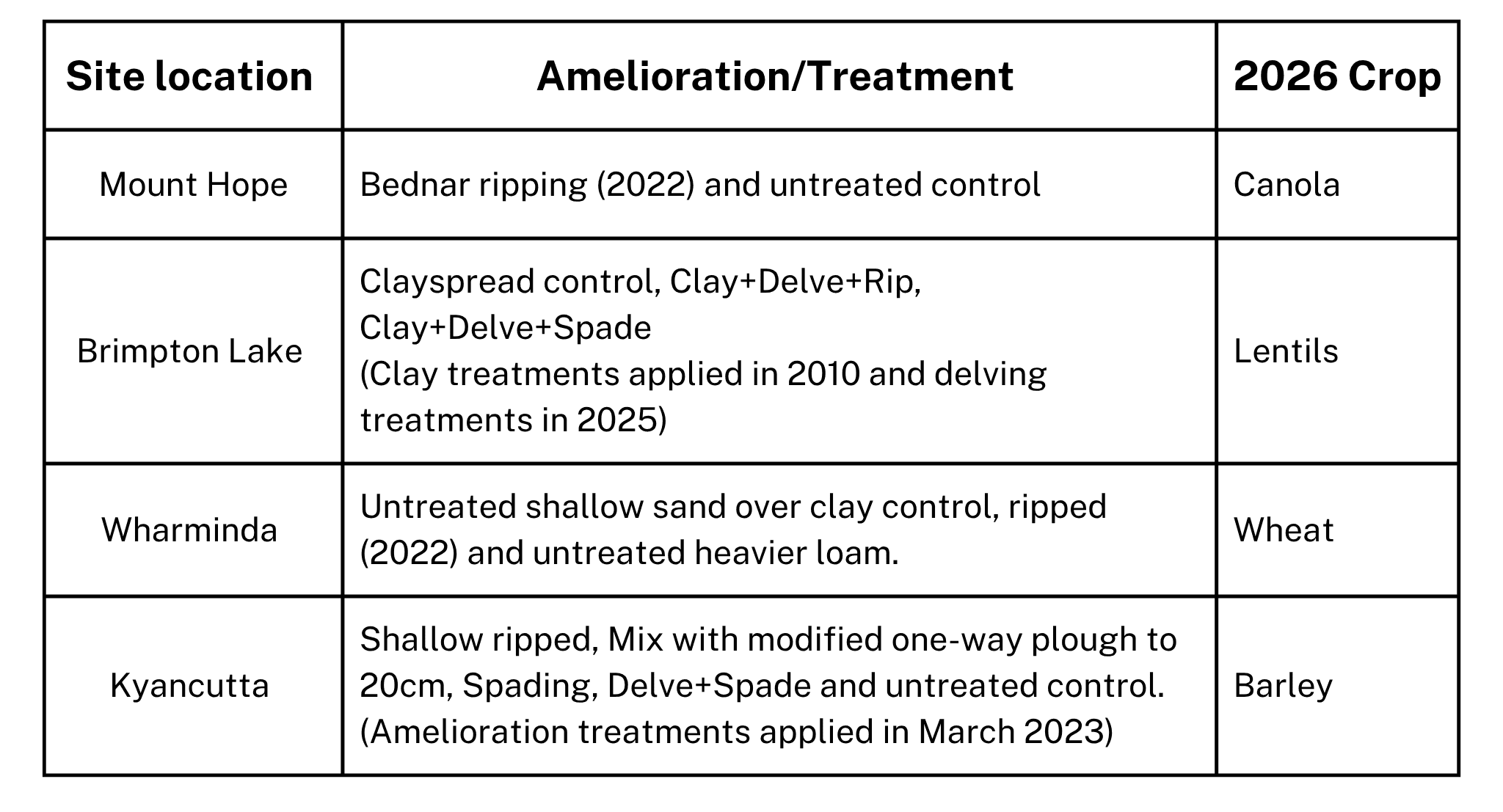
The ripped treatment at Mount Hope had 27% higher plant numbers than the untreated control (46 plants/m2 compared to 36 plants/m2). However, these both were still well within the canola establishment target.
Lentil establishment numbers were within 90-110 plants/m2 at Brimpton Lake, thus all within the target range. The baseline clay spread control did seem to be helping address water repellence which might have otherwise hindered establishment.
Wheat numbers at Wharminda were 119 plants/m2 on the untreated shallow, duplex sand over clay, with over 150 plants/m2 on the area which had been ripped several years prior to bring clay to the surface. Although the plant numbers were lower on the loamier soil than the ripped sand (123 plants/m2), early crop vigour was better with plants having larger, greener leaves and stems.
At Kyancutta, all of the ripping and mixing treatments resulted in higher plant numbers (140-150 plants/m2) than the control (108 plants/m2) on the siliceous sand. On the calcareous sand, the shallow mix using a modified plough had the same plant numbers at establishment as the untreated control (approx. 125 plants/m2). Treatments which had a more complete mix with the spader had plant numbers between 140-155 plants/m2.
All treatments, including the controls at all sites, had plant densities at establishment which were within the target range for the crop type. This highlights the conducive conditions for good plant establishment in 2026.
However, these field surveys also reflect the value of ameliorating soil constraints, such as water repellence, to improve crop establishment, vigour and soil health.
For further information on planning effective amelioration of sandy soils, contact:
Brett Masters, Research Agronomist, EPAG Research
Email: [email protected]
Acknowledgement
This article is brought to you by the EP Landscape Board’s Sustainable Agriculture Program, funded by the Australian Government’s Natural Heritage Trust under the Climate-Smart Agriculture Program.
