
A bumper season brings a critical opportunity: keep dry saline land covered
by Amy Wright and Chris McDonough
A bumper season for crop growth and grain yield has provided a valuable opportunity to build groundcover across areas previously affected by dry saline land. The priority now is to protect that cover through harvest, summer and into the next growing season.
For growers who have watched bare “magnesia patches” expand during difficult years, seeing crops growing across these areas is encouraging. However, a good crop does not necessarily mean the underlying problem has disappeared.
A summer heatwave on any bare saline soil with a moist profile acts like a vacuum cleaner on high, sucking salt to the surface. It must be avoided at all costs. But trials have shown that maintaining or creating even low levels of soil cover over summer can make remarkable improvements to crop germination in the following season, and begin to reverse this land degradation.
Improvements can begin within a single season, but maintaining cover over successive seasons will be important to sustaining progress and supporting longer-term soil health and productivity.
Why maintaining cover matters
Dry saline land (DSL), often referred to as “magnesia country”, occurs when natural salt from subsoil clays become mobile after wet seasons like 2026. Then hot, dry periods that follow draw the moisture with the salt up to the surface layers. The moisture evaporates and over time the remaining salt builds up and becomes highly concentrated in the top 5cm and toxic to crop establishment. The resulting bare patches only accelerate these processes with no cover over the summer months to protect the soil.
Large autumn rainfall events can temporarily leach some salt by 10-30cm and reduce salt concentrations around the seed zone, allowing plants to establish and even grow well even where bare patches had formed. However, the salt still remains and can quickly return at even higher surface levels if soil cover is not maintained for the following summer.
The timing of rainfall matters. Autumn rainfall can create useful establishment opportunities, while summer rainfall followed by hot, dry weather can lead to renewed surface salt accumulation.
Retained stubble and surface residues help reduce evaporation and the upward movement of salt-bearing moisture. Living plants also use moisture within the soil profile at depth, which helps prevent it even bringing the salt to the surface layers.
Initially if you can keep the salt spread at lower concentrations slightly deeper in the profile, and keep growing and maintaining cover, then every decent rainfall will help push salt down, rather than let it return to the surface. This process can help restore the land in the long term, even through the challenging impacts of droughts.
Farmer sites that clearly demonstrate these principles
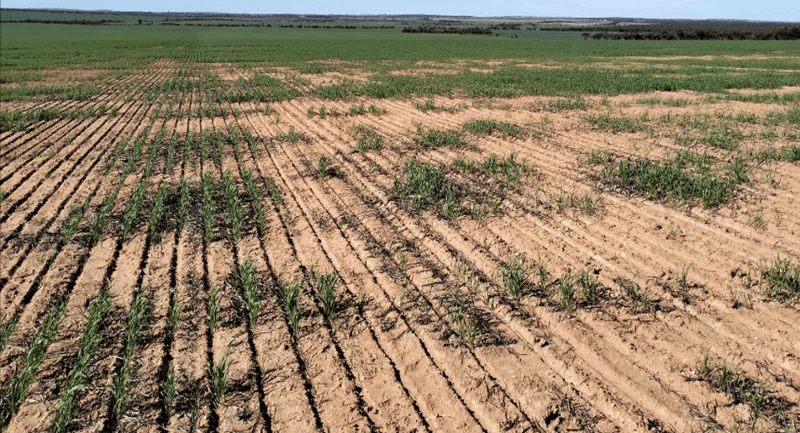
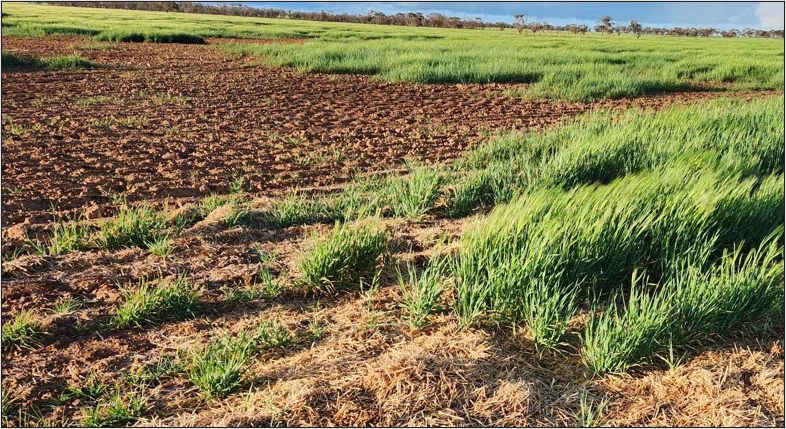
This 2023 Buckleboo DSL site showed crop growth only in patches where some summer straw cover was maintained after the wet 2022 season.
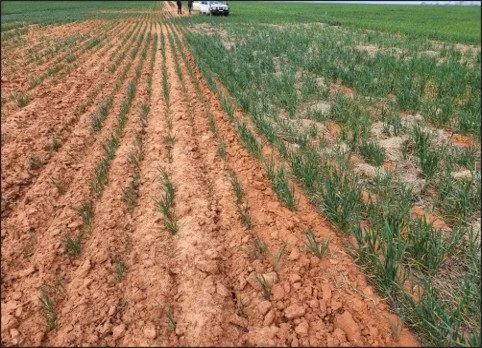
This farmer trial demonstration at Wentworth shows a complete contrast in crop establishment on a DSL patch when straw was spread in January prior to seeding.
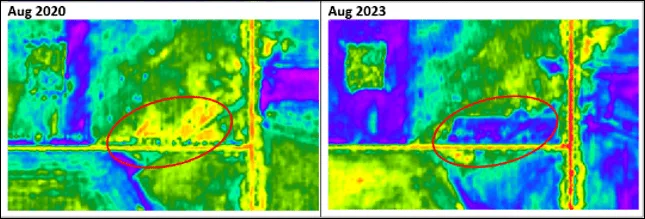
NDVI images of crop growth in seasons before and after Minnipa farmer Bruce Heddle spread a severe 5ha DSL patch with 5cm of residue from his chaff cart in the summer of 2023.
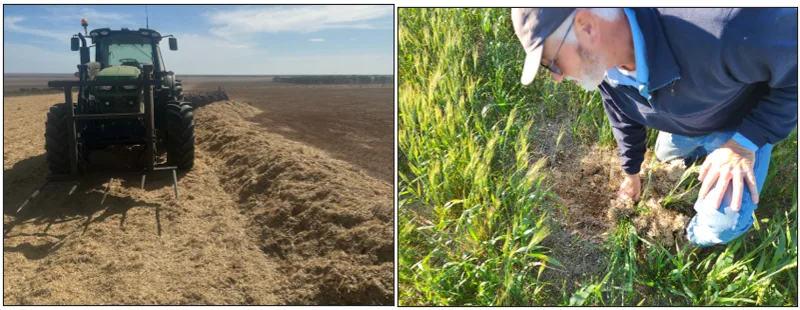
Impact of spreading a hay bale in summer over a severe DSL patch at Manangatang.
Protect the cover this season has produced
The extra biomass produced this year is a valuable resource for managing DSL. Harvest and summer management decisions should give particular attention to patches with a history of DSL, even where this year’s crop has made them harder to see.
Practical priorities include:
- Retain stubble and crop residues across affected patches to maintain protection through summer and autumn.
- Exclude livestock from vulnerable patches or delay grazing until autumn, ensuring sufficient cover remains whenever grazing occurs.
- Watch livestock camping areas, as sheep can concentrate on saline patches and leave them exposed even when the surrounding paddock remains well covered.
- Minimise unnecessary soil disturbance that removes or disrupts protective cover.
- Check persistent bare patches and consider whether targeted straw or other locally suitable treatments could help establish and retain cover.
Farmers who regularly graze susceptible paddocks over summer should consider the long-term soil health benefits of a more strategic and deliberate use of confinement feeding to allow removing livestock permanently from these areas.
Electric fencing available to help protect vulnerable patches
Decisions about grazing or removing residues need to account for the condition of the DSL patches themselves. A paddock with abundant feed can still contain vulnerable areas where cover is quickly lost. Growers wanting to protect dry saline land patches from grazing can access temporary RAPPA electric fencing systems through the Eyre Peninsula Landscape Board.
The systems are available free of charge for up to six weeks and provide up to 800 metres of three-wire electric fencing. Each package includes an energiser, posts, tread-ins, wire, clips and a fence voltmeter, with the RAPPA system designed to fit onto an ATV.
Loans are prioritised for land managers facing land degradation risks or significant fragile soil issues. Contact your local Landscape Board office to discuss availability and suitability. Further details are available in the RAPPA electric fencing loan information sheet.
Think beyond one good season
A productive crop is an encouraging sign, but it should be treated as a step towards recovery rather than proof that a DSL patch has recovered.
Mallee Sustainable Farming reports that covered soils have shown improvements in toxic surface salinity within a single summer. This demonstrates the value of protecting cover now, while recognising that recovery rates vary between sites. There is no fixed recovery timeframe that applies to every patch. Allowing areas to become bare again risks losing progress.
Build on the opportunity
AIR EP is continuing research and extension into managing dry saline land, including how growers can make use of favourable seasons and protect the cover achieved. Grower observations of what has worked, where cover has persisted and where patches have become bare again will help build practical knowledge for future management.
For further guidance, visit Mallee Sustainable Farming’s Dry Saline Land Decision Tree, which brings together management strategies, case studies, podcasts and videos, including experiences from Eyre Peninsula.
Protecting this year’s groundcover is an investment in next year’s establishment, and in the longer-term recovery of dry saline land.
Produced November 2026
Project acknowledgement
The NGN Managing and Mitigating Dry Saline Soils (Magnesia Patches) in South Australia, project code AIP2602-001RTX is funded by GRDC and led by AIR EP in collaboration with Northern and Yorke Landscape Board, Eyre Peninsula Landscape Board, Upper North Farming Systems, South Australian Research & Development Institute, Mallee Sustainable Farming, Agronomy Solutions and Insight Extension for Agriculture.

