
Critical Opportunity to Reduce Dry Saline Land Impacts
by Dr Chris McDonough, Insight Extension for Agriculture
Dry saline land (DSL), often referred to as ‘magnesia country’, is land degradation caused by transient subsoil salinity wicking to the surface through hot dry periods, and has been on the increase over the last decade.
The key to stopping and reversing DSL is to grow (or apply) soil cover, which must be maintained through summer months to stop the capillary rise of salt, which research has shown can easily concentrate in the top 5cm of soil to 2-3 times toxic levels for crop growth.
However, significant rainfall events can have the double impact of leaching some of that surface salt into the top 20cm, as well as diluting the salt around the seed zone to levels that may allow for germination (depending on the level of toxicity present). This is why seasons that have large autumn rainfall can temporarily diminish DSL impacts.
Recent research has also shown that the leached salt will soon return to the surface layers with dry weather, however, more work is needed to understand how quickly this may occur and for how long a window of opportunity may exist to achieve adequate plant establishment.
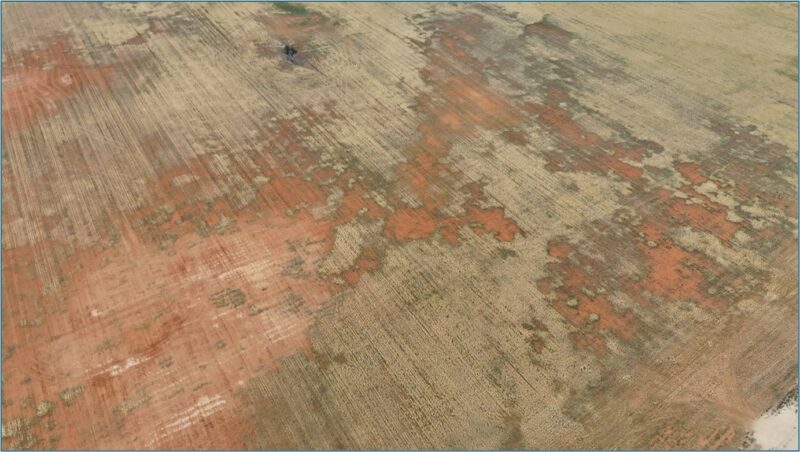
Many areas of the state recently received between 50-150mm of rain. Many farmers have been getting their seeders into action to get cover on eroding sandhills from the previous season. For farms that have large areas of bare DSL (as in the picture below), I believe that this also presents a significant opportunity to sow some barley as soon as possible to achieve soil cover.
Depending on soil types, severity and weather conditions, there may only be a 2-3 week period when seeds can germinate and establish, and we could still be in for a dry season, so even if this is just tried in some specific areas, I believe the knowledge gained for ongoing management could be invaluable. I would also consider not controlling volunteer growth in some of the worst areas, as the seed present when the rain fell may have got the best conditions to establish.
The value of establishing a crop, rather than just spreading straw, is that living roots will take moisture from 20-40cm depth, not allowing the salt bearing moisture to reach the surface layer during the growing season. However, all this good work can be quickly undone if summer grazing of the stubble leaves the ground bare, and sheep love to camp on these areas.
AIREP has recently secured project funding to further the research and extension into reversing the impacts of farmland salinity, which will include exploring the management dynamics around utilising opportunistic rainfall and maintaining the cover achieved. This may well prove to be the most practical and economic tool farmers have, for areas too large or unsuitable for spreading sand or straw.
The team at AIREP will be very interested to hear of the experiences (successes of failures) of anyone employing any of the strategies suggested in this article. There are no sure guarantees, and everyone’s circumstances will vary. It is also expected that many DSL areas will reduce in size due to the rainfall even if sown at normal times with the rest of the paddock.
I would also encourage anyone dealing with DSL issues to visit the Dry Saline Land Decision Tree at: https://msfp.org.au/dry-saline-land-2/ which includes vital information about this problem, 4 key strategies to overcome it and many case studies, podcasts and videos of successful management, including many from Eyre Peninsula.
The Sustainable Agriculture EP project is supported by the Australian Government through funding from the Natural Heritage Trust under the Climate-Smart Agriculture Program and delivered for the Eyre Peninsula Landscape Board, a member of the Commonwealth Regional Delivery Partners panel by AIR EP, EPAG Research, PIRSA and Ag VIC.
