EP Frost tactics | Crop choice & timing take the sting out of cold nights
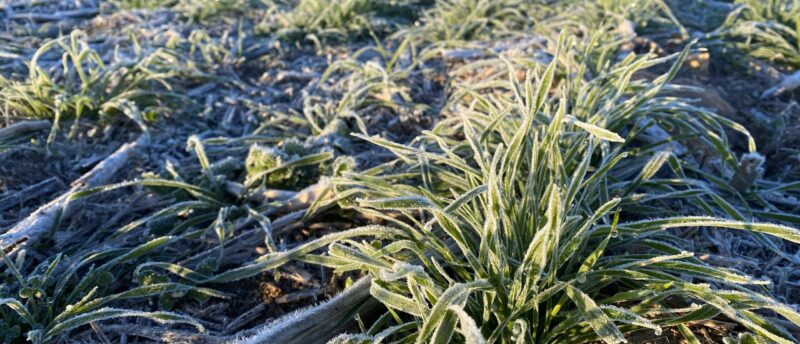
Frost remains one of the toughest seasonal risks for Eyre Peninsula growers, particularly in high-risk paddock zones, where a few cold nights can make a big difference to grain yield and quality.
Throughout 2025, the GRDC funded ‘Further tactics to minimise frost damage on the Eyre Peninsula’ project focused three key components – cereal phenology, break crop phenology, and nutrition.
Following the work undertaken in previous seasons, researchers continued to test practical ways to minimise frost damage, including crop choice, variety phenology, sowing time, nutrition, and zoning of frost-prone areas.
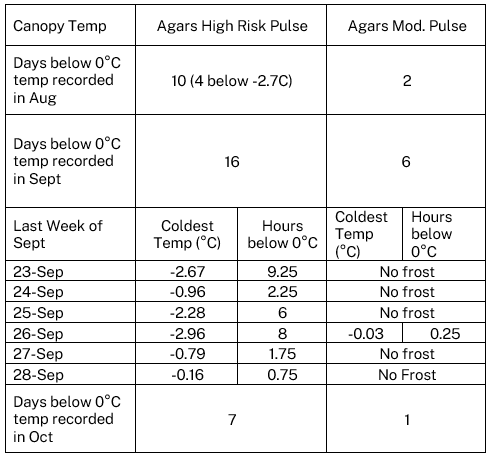
In a relatively low frost event year, the season delivered plenty of cold canopy temperatures, especially at the high-risk pulse site near Tooligie Hill. In that zone, canopy sensors recorded 10 days below 0°C in August, 16 days below 0°C in September, and 7 days below 0°C in October.
The last week of September was particularly cold, with several nights below zero and one night falling to nearly -3°C. See Table 1 below.
It is important to note that despite the cold mornings in September, very little frost damage was recorded both in trials and across the high frost risk areas of EP in 2025.
Table 1. 2025 frost event summary (Agars site)
Investigating break crop phenology
Leading into the 2025 season, the Steering Committee decided that the one of the most significant knowledge gaps was in understanding the relative damage frost is causing to the various break crops, including the role that phenology might be playing in evading frost events.
As such, a paddock near Tooligie Hill was located due to a history of varying frost zones and levels of impact. The 2025 break crop trial site included vetch, lentils, lupins, faba beans, canola and faba bean/lentil blend.
Despite a run of cold nights recorded, no obvious frost damage was recorded in the low risk (green) or high risk (red) break crop trial zones (Tables 2 and 3).
This does not indicate pulses are frost-proof. It merely highlights the importance of ongoing trial work to provide data across several seasons, to assess the impact of frost in break crops across different zones.
Table 2. Frost Zone Break crop trial (Low Risk) summary
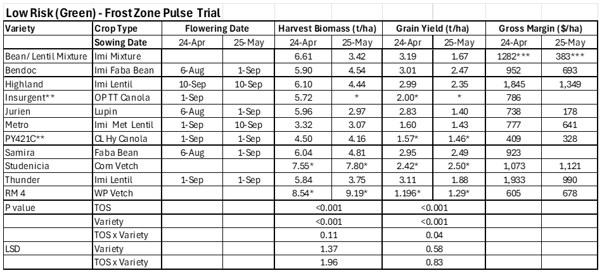
Table 3. Frost Zone Break crop trial (High Risk) summary
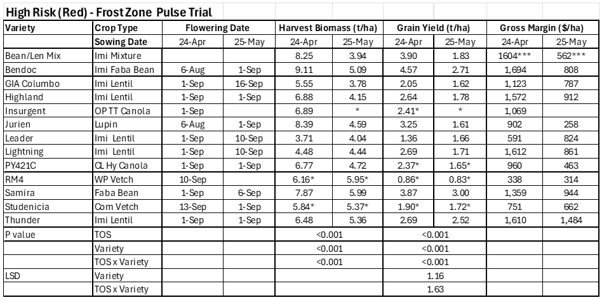
* Extrapolated from cuts
** Canola severely grazed by either kangaroos or rabbits into July, effecting flowering and maturity time + yield
*** added $50/t for cleaning
Further learnings in cereal phenology
Building on from trials since 2022, a further set of cereal phenology trials were implemented in 2025. Wheat and barley varieties, along with variety mixtures with differing phenology and maturity, were sown across moderate and high frost risk zones.
Cereal varieties included:
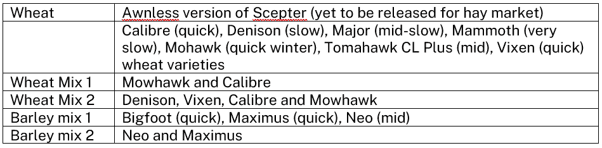
Trials were sown at three different times - one irrigated around ANZAC Day, one sown dry to emerge at the break of the season and one sown on 19 June. (Table 4).
Table 4. Time of sowing and yield % relative to Vixen (TOS2) of different cereals in the high (red) and moderate (orange) risk zone cereal trials at Agars’ and Kay’s near Lock in 2025. TOS 1 Kay’s (both High and Mod Risk) irrigated on 23 April, TOS 2 Kay’s sown 12 May (dry) emerged following rain 26 May, TOS 3 Agars’ sown 19 June. The dates in the columns are the date each variety reached GS65 (mid-flowering).
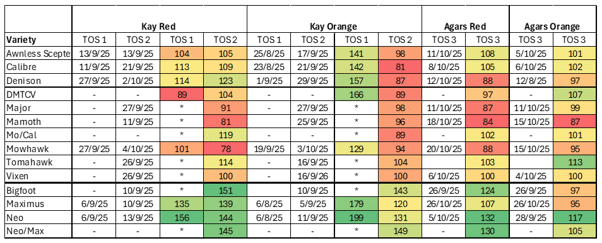
Establishment in the original sites was patchy due to the soil displaying high levels of water repellence, and irrigation running along the furrows before infiltrating sporadically. These sites were also exposed to wind damage post establishment, delaying phenology.
This presented an opportunity to collect phenology information across a number of establishment dates, however no frost damage was observed.
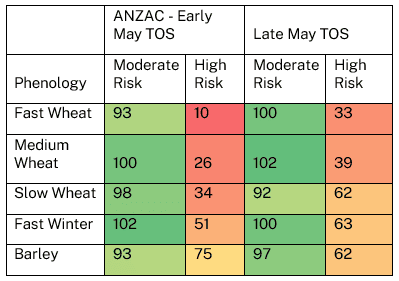
Long term results from trials conducted in 2022, 2023 and 2024 suggest that relative performance differs markedly between high- and moderate-risk frost zones, with slower wheat phenology, quick winter wheats and barley often performing better than fast spring wheats in high-risk situations, particularly when sown early. This longer-term context remains important when interpreting the more benign 2025 season (Table 5).
Table 5. Long term (2022-24) grain yields expressed as a % of a medium phenology wheat (e.g. Scepter) yield sown around ANZAC Day and late May in two different frost risk zones at Tooligie.
One of the most definitive messages from 2025 is that frost risk is not just about how cold it gets. Damage depends on the crop, growth stage, flowering timing, landscape position and how long the canopy stays below critical temperatures.
Key messages
For growers with known frost-prone areas, the most practical starting point is to separate paddocks into risk zones and consider the following:
- Barley continues to perform more reliably than fast wheat in high frost-risk zones. Long-term results from 2022–24 showed barley holding up better than wheat, where frost risk was high.
- Fast spring wheats sown early carry the highest risk in frost-prone areas. In the high-risk zone, early-sown fast wheat yielded only 10% of the medium wheat benchmark in the long-term dataset.
- Slower spring wheat varieties, fast winter wheats and barley can help spread flowering and reduce exposure. They are not frost-proof, but they offer more flexibility.
- Later sowing helped reduce frost losses in some high-risk wheat comparisons. Late May sowing improved the relative performance of fast and slow wheats in high-risk zones compared with ANZAC Day/early May sowing.
- Nutrition and frost protection products did not improve wheat yield in the 2025 trials. Ten treatments were tested across four wheat trials, and none produced a significant yield benefit. This is consistent with 2024 results.
- Zoning can be used to treat frost-prone areas differently. The lowest, coldest parts of paddocks may be better suited to barley, hay options, later flowering types, or lower-input strategies.
Next steps
The best frost strategy starts before seeding.
Use paddock history, elevation, yield maps and local knowledge to identify where frost regularly bites. Then match those zones with crop and variety choices that reduce exposure during flowering. Build the frost plan into the rotation, sowing program and variety package.
Further information
Frost project updates and resources are available on the AIR EP project page.
Acknowledgement
Thank you to the Agars and Kay families for hosting the trials, advisers, researchers and project partners who provide input and direction for the project, collected data and shared paddock experiences throughout the 2025 season.
This work was funded by the GRDC NGN project ‘Further tactics to minimise frost damage on the Eyre Peninsula’, AIP2404-001RTX led by AIR EP and delivered by EPAG Research.