RiskWi$e: July Rainfall Lifts Yield Potential Across EP
There’s Still Upside – July Rainfall Lifts Yield Potential Across EP
Prepared by Andrew Ware and Jake Giles, EPAG Research
Better Rain, Better Outlook – But Know Your Soil and Season
July has brought a welcome turnaround to what started as a very tough season. Much of the Eyre Peninsula is now sitting close to or above median growing season rainfall (GSR), and while crop establishment was generally late and subsoil moisture remains patchy, there is now genuine upside in many paddocks.
Key rainfall highlights for July (to date) from selected AIR EP rainfall gauges:
- Cummins: 120 mm (45 mm in the past 7 days)
- Kimba: 93 mm (23 mm in the past 7 days)
- Minnipa: 72 mm (24 mm in the past 7 days)
This recent rain has lifted potential yield across the region – as captured in the latest Yield Prophet simulations for key sites.
How Much Has Yield Potential Improved?
The table below shows the nitrogen-unlimited grain yield potential for a wet (25%), average (50%) and dry (75%) finish to the season, modelled for three dates in July. It clearly shows how additional rainfall has improved the seasonal outlook, particularly where soils have decent water-holding capacity.
Table 1: How Yield Prophet Nitrogen Unlimited Yield Predictions have changed over the last month – with favourable rainfall conditions (yield t/ha).
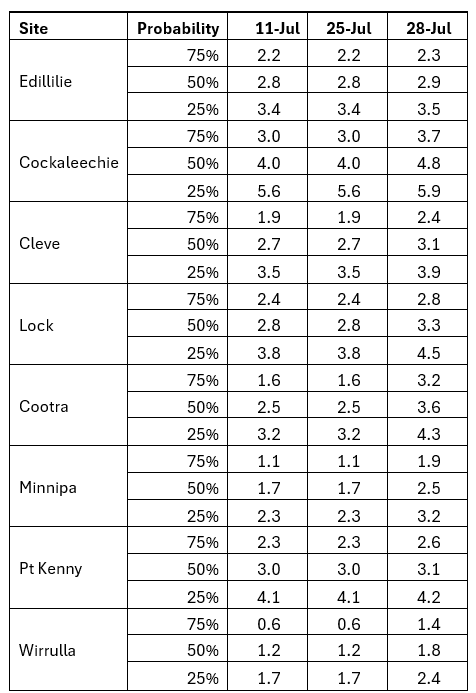
Biggest gains seen at Cockaleechie, Lock, Cootra and Pt Kenny.
More modest gains at Edillilie – reflecting lower soil plant available water capacity (PAWC).
Even though it’s wet now, not all soils are storing water efficiently.
Nitrogen Decisions: Step-by-Step Thinking
Making nitrogen decisions in 2025 is challenging. High urea prices, stretched logistics, and tight cash flow are real issues for many. But the opportunity to respond to higher yield potential exists—provided it’s supported by the paddock. Crops will respond to applied nitrogen well past growth stage 31, provided they receive adequate moisture to enter the root zone.
Yield Prophet uses known soil water, crop stage, weather forecasts and historical climate data to estimate likely yield outcomes. From there, the crop’s nitrogen needs can be calculated.
Rule of thumb: ~40 kg N is required to grow 1 t/ha of wheat
For example, if your crop now has potential to yield 3 t/ha (under a 50% season), it will need ~120 kg N/ha. Subtract what’s in the soil and what’s already applied to work out the N gap—and what top-up, if any, might be warranted.
What Makes the Difference?
From across the EP, we’ve seen that:
- Soil type matters – poor PAWC soils (e.g. Edillilie) limit yield response even with good rainfall.
- Crop establishment timing matters – the Yield Prophet yield predictions reflect the later seasonal break, where the ability to build biomass is limited and exposure to higher damage from heat.
- Stored moisture matters – Yield Prophet models take this into account, but growers should check rooting depth and actual moisture via probes or a shovel.
- N supply is still a lever to pull – if crops have potential, and urea is available, a top-up may be justified.
Making the Call: Questions to Ask
Before applying more N:
- Do you know how much N is in the soil?
- Can you access urea?
- What’s the forecast for the next 2–3 weeks?
- What’s the return if the crop meets 50% or 25% season potential?
Working through these questions helps break down a complex decision into manageable parts.
Even after a historically dry start, there are still real opportunities to grow grain this year. The recent rain has shifted the outlook – but the variation across soil types and subsoil conditions is just as important as the rainfall itself.
Take the time to understand your paddocks.
If in doubt, tools like Yield Prophet—and support from local advisors—can help make more confident, data-driven nitrogen decisions.
For more insights or help interpreting your own paddock data, get in touch with the AIR EP or EPAG Research teams.
Check out the EP RiskWi$e project page for past Yield Prophet reports.