RiskWi$e: N in lower EP farming systems
When the season turns wet - should we carry more N into it?
By Andrew Ware, EPAG Research
Lower Eyre Peninsula growers have been very effective at applying higher N rates in recent years to drive higher cereal and canola yields, but is there a limit to how effective this can be in wetter years?
The 2026 season makes the question obvious, but the conditions are not especially rare. At Cummins, about 344 mm fell from the start of April to 27 August and the Yield Prophet rainfall trace was close to a Decile 9 trajectory by late August. A Decile 8-or-better rainfall year occurs three years in ten by definition; a Decile 7-or-better year occurs four years in ten. More importantly, a CliMate analysis for Cummins shows that a rolling 30-day rainfall total above 100 mm between 1 June and 30 July occurred in 16 of 47 years (34%) from 1980 to 2026.
So the challenge is not just how to manage the occasional extraordinary season. It is how to build an N strategy that can cope with quite regular periods of high winter rainfall, while still protecting profit in average and dry years.

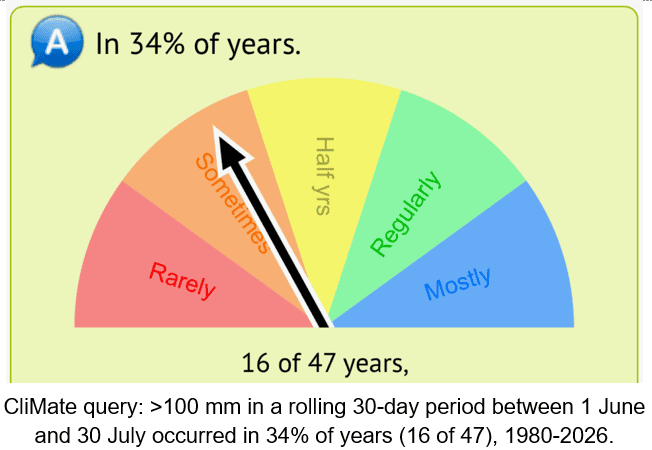
The central question is not whether crops need more N in a wet year. It is whether all of that extra N can be supplied efficiently after the season has already declared itself.
Can we topdress our way to very high yield?
For wheat, the familiar budgeting rule of thumb is about 40 kg/ha of available N per tonne of grain. The calculation is straightforward: a 5-6 t/ha crop needs access to roughly 200-240 kg N/ha from soil mineral N, mineralisation and fertiliser combined. The important question is where that N comes from - not the multiplication.
Results from the GRDC Hyper Yielding Crops (HYC) program are highly relevant. Since 2016, optimum applied fertiliser N rates in the highest-yielding HYC crops have rarely exceeded about 200 kg N/ha, even when total crop N uptake was much higher. This is not a hard physiological ceiling and it should not be transferred directly to EP, but it does challenge the idea that the N requirement of a very high-yielding crop can always be met simply by continuing to add larger amounts of current-season fertiliser. High-yielding crops commonly rely on a combination of starting mineral N, in-season mineralisation and fertiliser N.
| HYC evidence | What it suggests |
| HYC since 2016 | Optimum applied fertiliser N has rarely exceeded ~200 kg N/ha in the highest-yielding crops. |
| Wallendbeen 2022 | With high starting soil N and a fertile rotation, wheat yielded 9.26 t/ha in the near-nil fertiliser N treatment; applying 80-280 kg N/ha did not increase yield. |
| 23 HYC N experiments | Maximum yields ranged from 4.2-13.1 t/ha. Negative yield responses to additional N were common in experiments yielding above 9 t/ha. |
| Main lesson | High yield can require very high total N uptake, but soil N supply and mineralisation are a major part of how successful crops meet that demand. |
There is also a warning in the HYC results. Once N supply was adequate, extra fertiliser sometimes increased protein or biomass rather than grain, increased lodging pressure, and in some experiments reduced yield. In other words, the goal is not “more N at any cost”. The goal is to have enough N available, from the right sources and in the right part of the profile, when the crop can use it.
Why June and July can be a high-risk N window
High winter rainfall can create a supply-demand mismatch. During June and much of July, soils can be near field capacity or periodically saturated while wheat is still tillering and has not yet reached peak N demand. The GRDC Nitrogen Reference Manual indicates that wheat has accumulated only about half of its final crop N by the start of stem elongation; maximum daily uptake occurs during stem elongation and about 90% is generally accumulated by flowering. Large nitrate pools present well before that demand develops are therefore exposed to drainage and denitrification for longer.
Australian 15N work on waterlogging-prone Chromosols in south-western Victoria shows the potential scale of that risk. When labelled urea was delayed until mid-tillering to first node, 64-84% of the fertiliser N was recovered in the crop plus sampled soil at maturity. When the same N was applied at sowing or shortly after emergence, recovery fell to 7-42%. In some high-rainfall-zone experiments, 77-93 kg N/ha from a 100 kg N/ha sowing application was not recovered in the crop or sampled soil. That “missing” N cannot all be assigned to one pathway - some may have moved below the sampling depth - but the evidence points to drainage and gaseous losses during wet or waterlogged periods. These Victorian figures should not be transferred directly to Lower EP, but they demonstrate why repeated 100 mm-plus winter rainfall periods can materially increase the risk of carrying a large nitrate pool before crop demand catches up.
Older Lower EP work led by Dr Therese McBeath through the GRDC Stubble Initiative provides a useful local comparison. Across 2015 monitoring sites, estimated N-use efficiency ranged from only 12-16% of available N on Lincoln sand-over-gravel soils to 48-68% on the Cummins deep clay, highlighting the importance of soil type, rooting constraints, crop sequence and background fertility. In a Cummins 15N experiment, 120 kg N/ha-equivalent labelled urea applied on 3 July was recovered at about 50-51% in above-ground biomass of April-sown wheat, but only 26% in wheat sown on 14 May. This single experiment cannot tell us where all unrecovered N went, but it reinforces the risk of relying on large winter applications when crop and root development are still relatively small.
The practical implication is not that June and July applications should be avoided. They are often essential. Rather, the efficiency of a large application depends on how quickly the crop can capture it relative to rainfall, drainage, waterlogging and microbial processes. Where heavy winter rainfall coincides with small crop demand, nitrate can move deeper in the profile, be temporarily immobilised, or be lost through leaching and denitrification before peak crop demand arrives.
There is an important distinction here: nitrous oxide is usually only a small part of total N loss in dryland cropping. Under saturated conditions, denitrification can also produce N2, while nitrate can move below the effective root zone. The practical risk is therefore broader than N2O emissions alone - it is loss of plant-available N from the crop-soil system at a time when the crop is still relatively small.
Mineralisation is the other side of the wet-season story
A wetter season is not only a story about N loss. Where soils remain moist but sufficiently aerated, rainfall can also support microbial turnover of soil organic matter and residues, increasing the amount of N mineralised during the season. In a high-yielding year this soil-derived N can be extremely valuable because it contributes to crop supply without requiring another fertiliser pass, and it may partly explain why some high-fertility paddocks continue to support rapid crop growth when fertiliser-only budgets suggest they should be short of N.
For a rough sense of scale, the widely used “Ridge” rule estimates mineralisation as 0.15 x topsoil organic C (%) x growing-season rainfall (mm). At 400 mm GSR that gives about 60 kg N/ha from a 1.0% OC soil, 90 kg N/ha at 1.5% OC and 120 kg N/ha at 2.0% OC. Those numbers are useful for appreciating the possible size of the contribution, but not as paddock-specific predictions: in western Victorian data the relationship was only moderate, and the GRDC review concluded that current tools struggle to predict mineralisation accurately at the field, season and spatial scale growers actually manage.
Older South Australian work by Xu, Ladd and Elliott shows just how large the underlying soil N-supply potential can be - and why a single organic-C x rainfall rule can be misleading. Across 123 cereal-zone soils, laboratory mineralisable N in the 0-10 cm layer ranged from about 14 to 121 kg N/ha, with a median close to 50 kg N/ha; the 10-20 cm layer contributed another 5-42 kg N/ha. These are potential mineralisation measurements under controlled incubation, not amounts growers should expect to receive in a paddock, but the nearly ten-fold range is important.
In that work, combinations of organic C, total N, C:N ratio, pH, bulk density and field capacity explained much more of the variation in mineralisable N than any single soil measure. This is consistent with the more detailed French modelling work reviewed with Murray Unkovich: mineralisation is a soil x season x management process. Rainfall and temperature determine how much of the potential is expressed, while texture, water-holding capacity, pH, the amount and quality of organic matter and crop history determine the size and behaviour of the underlying N pool.
This is why more detailed approaches are attractive. French work by Clivot and colleagues used field measurements and the LIXIM framework to separate mineralisation from nitrate movement across 65 arable soils. Potential mineralisation varied almost ten-fold between soils. A model using soil organic N, clay content, pH, C:N ratio and CaCO3 explained 61% of the variation; adding rotation history increased this to 72%. That is consistent with the approach explored in our earlier work with Murray Unkovich: mineralisation is better thought of as a soil x season x history process than as a fixed function of organic carbon and rainfall. On Lower EP, texture, pH, organic matter, legume history, amelioration, soil moisture and rooting depth can all change how much N becomes available and when.
There is also a useful systems implication: an N reserve does not have to exist entirely as nitrate waiting in the profile. The companion Xu, Amato, Ladd and Elliott study found median mineral N to 60 cm at sowing of about 75 kg N/ha after pasture, 69 kg N/ha after grain legumes and 47 kg N/ha after cereals, with very wide ranges between sites. A five-year 15N study within that work showed a close link between labelled N in soil mineral N at sowing and N subsequently recovered by the crop. This supports a broader view of “N storage”: N can cycle through residues, microbial biomass and soil organic matter, mineralise between crops, and reappear as plant-available N when conditions allow. Maintaining N fertility may therefore be more relevant than simply trying to store a large pool of nitrate from one season to the next.
Local EP results point in the same direction
Work conducted through previous EP projects provides a local example. At Lock in 2022, a highly productive zone began with about 180 kg N/ha of mineral N and produced around 6.5 t/ha wheat with little yield or protein response to additional fertiliser. Other zones with lower starting N responded to added N, but only where soil and crop constraints allowed that N to be converted into yield.
The Edillilie N-priming work shows that carryover is possible, but also highlights the balancing act around timing. A September 2024 application followed by about 15 mm of rain resulted in roughly half of the additional N being measured in the following April soil tests. Later applications had poor recovery under drier conditions. Waiting later gives more confidence that the current crop has sufficient N and that the extra N is genuinely surplus, but reliable incorporation rainfall becomes progressively harder to forecast.
The Edillilie Farming Systems trial adds another important dimension. Across 2023-25, the Decile 2 N strategy mined about 105 kg N/ha from the system, Decile 5 was approximately N-neutral, and Decile 7 accumulated the largest N surplus. The extra fertiliser invested in the Decile 7 treatments has not produced additional economic value so far - but those three seasons were two below-average seasons and one around average. How those treatments perform when a Decile 7-or-wetter season arrives may be pivotal to their long-term profitability. That is precisely why this question needs to be judged across seasons rather than from a single-year gross margin.
A high-N strategy only has value if the N is retained, remains accessible, and helps capture yield or quality that would otherwise have been missed.
Where might an N reserve make sense?
Lower EP is particularly complex because soil type can change dramatically within a paddock. Those differences affect water holding capacity, rooting depth, drainage, mineralisation, N retention and ultimately the crop’s ability to convert N into grain. The same paddock can contain zones where carrying extra N is relatively low risk and zones where it is a poor bet.
The most promising candidates are likely to be consistently productive soils with good rooting depth and water supply, including many duplex soils where nitrate moving below the sandy surface remains within an accessible root zone. There may also be a growing opportunity on successfully ameliorated soils. Deep ripping, spading, claying or other amelioration can substantially increase rooting depth, crop water use and yield potential; where amelioration has genuinely expanded the effective root zone, the crop may be better able to access N stored deeper in the profile.
But “ameliorated” does not automatically mean “safe to bank N”. Deep ripping a very low-CEC sand may improve rooting and water extraction without greatly increasing the soil’s ability to retain nitrate. By contrast, soils with more clay at depth, or amelioration that incorporates clay or organic matter, may offer a better combination of storage and root access. Chronically waterlogged zones, hostile subsoils, shallow rooting and deep freely draining sands remain higher-risk places to carry large mineral N reserves.
This spatial diversity is one reason whole-paddock N rules can be unsatisfactory. The N strategy should increasingly follow each zone’s capacity to store plant-available water, retain mineral N, mineralise organic N and support rooting and yield - not simply the paddock average. The same rainfall year can therefore create very different N opportunities and loss risks within one paddock.
The older LEP NUE monitoring illustrates the same point. At Lincoln, sand-over-gravel zones could carry high mineral N and produce large biomass but still convert little of that N into grain because other soil constraints limited yield. By contrast, the Cummins deep clay had much higher apparent NUE and strong microbial turnover. The opportunity to carry N should therefore be targeted to zones that can both retain the resource and convert it into yield, rather than simply to zones with a history of high fertiliser response.
When could the economics stack up?
There is no “free” N bank. Extra fertiliser carries a purchase cost, application cost, financing cost and some probability of loss. If the N simply sits in the soil and replaces exactly the same fertiliser next year, there is little economic magic in moving the purchase forward.
The value comes from flexibility. A reserve may contribute to the current crop, remain available to the next crop, support a larger pool of organic N that can mineralise in favourable conditions, reduce dependence on very large winter topdressings, or allow a crop to respond immediately when a Decile 7-or-wetter season develops. The economic case is therefore strongest where:
- high yield potential occurs often enough for N deficiency to carry a meaningful opportunity cost;
- soil and root-zone characteristics give a reasonable chance of retaining N for later use;
- winter rainfall frequently makes large in-season applications difficult or inefficient;
- the farming system has been running a negative N balance and background fertility is declining; and
- grain value relative to fertiliser cost makes the upside from extra yield or protein worthwhile.
Long-term N-bank work elsewhere in southern Australia points to the same principle: the profitable target is usually a locally appropriate N reserve with a neutral to modestly positive system N balance - not the largest possible mineral N pool. That target will vary with rainfall, soil, yield potential and loss risk.
A practical way to test the strategy
- Zone the paddock first. Use yield maps, soil/EM information, amelioration history and drainage patterns to separate zones with different PAWC, rooting depth, mineralisation potential and N-loss risk. Variable-rate N storage is more defensible than a whole-paddock rate where soils are highly variable.
- Establish the starting position. Deep-test mineral N and PAW by representative zone. Where the decision is important, also track topsoil organic C/total N, pH, texture and crop/legume history. These measurements will not perfectly predict mineralisation, but they help distinguish soils likely to have strong biological N supply from soils that will remain heavily dependent on fertiliser.
- Track the system N balance. Record fertiliser and legume N inputs against grain N removal. Persistent low grain protein and negative N balances are warning signs that tactical fertiliser decisions may be progressively mining background fertility.
- Build reserves gradually and conditionally. Rather than jumping to a large N bank, test modest increments such as 25-50 kg N/ha in high-potential zones once the current crop is adequately supplied. Timing should balance confidence that the N is genuinely surplus to the current crop against the declining reliability of incorporation rainfall later in spring.
- Measure where the N goes. Re-core by depth before the next crop and retain nil/low-N reference strips or paired treatments where practical. In wetter winters, consider additional profile sampling after major rainfall events to distinguish N moving deeper from N genuinely disappearing. Following crop biomass, grain protein and N removal helps estimate how much N was actually recovered.
- Re-price the strategy each year. Judge the treatment over several seasons and include fertiliser price, spreading cost, financing, yield/protein response, residual N value and the probability of N loss. A reserve that makes sense at one urea:grain price ratio may not at another.
What can we say now?
The evidence does not justify a blanket recommendation to “over-fertilise”. It supports a more useful proposition: repeatedly running the system N balance too low can mine fertility, while very high-yielding crops appear to depend on substantial soil N supply and mineralisation because ever-larger in-season fertiliser rates become increasingly inefficient and can sometimes be counterproductive. At the same time, carrying a large nitrate pool through wet early winter can increase environmental and economic loss risk. The opportunity is to find the middle ground - enough fertility in reserve, in the right soils and forms, without unnecessarily exposing N to loss.
For Lower EP, the emerging strategy may be a combination of four things: tactical in-season N, avoiding persistent negative N balances, recognising and valuing the soil’s capacity to mineralise N, and selectively carrying a modest N reserve in soils and zones where it can be retained and used. The balance between those sources will differ substantially across soil types, seasons and paddock zones.
The aim is not to predict the next very wet season. It is to be able to “play the season” as conditions dictate without discovering, halfway through a Decile 7-or-wetter year, that the farming system has too little accessible N - or too little capacity to capture additional fertiliser efficiently - to make full use of the water and yield potential available.
Selected evidence base
- EPAG Research project results: Lock, Cockaleechie and Edillilie N management/priming work (2020-25).
- Farming Systems South - Edillilie trial insights 2023-25 (draft report, Adelaide University/EPAG Research/AIR EP collaborators).
- GRDC Hyper Yielding Crops research: Poole and collaborators, GRDC Grains Research Updates; FAR Australia HYC annual results.
- Jones BR, Poole N, Warren D, Bloomfield M & Vague A. 2024. Excess nitrogen also reduces yield in high yielding wheat crops. Australian Agronomy Conference.
- Hunt and collaborators - GRDC/University of Melbourne N-bank research and long-term N management work.
- Bureau of Meteorology Cummins Aero daily observations, 2026; Yield Prophet and CliMate rainfall analyses supplied for Cummins.
- Unkovich MJ et al. 2020. A Nitrogen Reference Manual for the Southern Cropping Region. GRDC.
- Armstrong RD, Wallace AJ & Dunsford K. 2021. Nitrogen fertiliser use efficiency “rules of thumb” - how reliable are they? GRDC Grains Research Update.
- Harris RH, Armstrong RD, Wallace AJ & Belyaeva ON. 2016. Delaying nitrogen fertiliser application improves wheat 15N recovery from high rainfall cropping soils in south-eastern Australia. Nutrient Cycling in Agroecosystems 106:113-128.
- Wallace AJ et al. 2020. Nitrogen use efficiency of 15N urea applied to wheat based on fertiliser timing and use of inhibitors. Nutrient Cycling in Agroecosystems 116:41-56.
- Clivot H et al. 2017. Quantifying in situ and modelling net nitrogen mineralisation from soil organic matter in arable cropping systems. Soil Biology & Biochemistry 111:44-59.
- McBeath T, Gontar B, Ware A, Gupta V, Kroker S, Flint A & Hunt E. Nitrogen Use Efficiency in LEP Farming Systems. GRDC Stubble Initiative work, projects LEA00002 and CSA00036.
- Xu ZH, Ladd JN & Elliott DE. 1996. Soil nitrogen availability in the cereal zone of South Australia. I. Soil organic carbon, total nitrogen, and nitrogen mineralisation rates. Australian Journal of Soil Research 34:937-948.
- Xu ZH, Amato M, Ladd JN & Elliott DE. 1996. Soil nitrogen availability in the cereal zone of South Australia. II. Buffer-extractable nitrogen, mineralisable nitrogen, and mineral nitrogen in soil profiles under different land uses. Australian Journal of Soil Research 34:949-965.