
New Project | Is Poor Water Quality Holding Back Your Flock?

New SA Discovery Farms Trial Investigating the impacts of water quality on sheep production and performance
Water is essential to livestock survival, with sheep drinking anywhere between 3 to 14 litres per day. While sheep are generally more tolerant of saline water than other livestock such as cattle, high salinity and poor water quality can still quietly undermine flock performance. Poor drinking water reduces daily water and feed intake, directly impacting growth rates, wool production, body condition, reproductive performance, digestion, and overall immune function.
In extensive grazing regions across South Australia, many producers rely on bore water, as underground water is drawn from aquifers surrounded by sediment and rock, it often contains elevated levels of Total Dissolved Salts (TDS).
To better understand these impacts and evaluate potential solutions, a major 30-month project Water Quality in Extensive Grazing Systems is currently underway. Led by researchers at the South Australian Research and Development Institute (SARDI) as part of the Australian Government’s Future Drought Fund SA Discovery Farms initiative, the project tests whether water quality negative impacts of high-salinity water on sheep production, and how novel technology can be used to improve water quality provided to livestock.
Why This Work is Needed
Guidelines show that dry mature sheep can tolerate water up to 4,000 mg/L TDS without major adverse effects; however, production losses and health issues, including scouring and reduced feed intake, can start to present as TDS levels rise; especially for lactating ewes and young lambs, which are far more sensitive.
When faced with poor quality or salty water, sheep often restrict their intake, leading to:
- Reduced dry matter intake and lower average daily gain (ADG)
- Poorer body condition scores (BCS)
- Stress on reproductive traits, including conception and weaning rates
- Gut distress and compromised temperature regulation
If water conditioning technologies can cost-effectively improve water palatability and animal performance during dry spells and drought, it can provide producers with an invaluable tool for drought resilience.
How the Trial Works: A Two-Stage Approach
The project is structured in two distinct phases:
Stage 1 (Research Stations Validation): Testing and validating the technology across three SARDI research farms representing different climate and water environments:
-
- Kybybolite (Struan): 231 ewes on medium-salinity bore water.
- Minnipa Agricultural Centre: 193 ewes on low-salinity water.
- Turretfield Research Centre: 200 ewes on low-salinity water.
At each site, ewes are split into two groups: one drinking existing farm/mains supply (control) and one drinking water treated via a solar-powered Hydrosmart “shuttle” conditioning unit installed at the trough. Advanced AgTech, including EID tag readers at water troughs, and blood sampling, enables the ongoing monitoring or live weight, body condition changes, trough visitation frequency, and animal health every 3 months.
Stage 2 (On-Farm Producer Demonstrations): Partnering with commercial livestock producers across SA regions to validate the findings under practical, paddock-scale conditions.
Early Findings: What the Data Shows
Early trial monitoring highlights a clear pattern: preliminary analysis shows that water conditioning depends heavily on the initial water source and salinity level.
- Kybybolite Research Centre (Bore Water, TDS ~2,300–2,500 mg/L): Where ewes relied on naturally saline bore water, access to water conditioned by the Hydrosmart unit resulted in a noticeable performance boost. Ewes drinking treated bore water achieved an average daily gain (ADG) of 105.5 g/day, compared to 78.6 g/day for those on untreated bore water, an increase of approximately 26 grams per head per day.
- Minnipa & Turretfield (Mains Supply, Low TDS < 600 mg/L): At sites with clean, low-salinity mains water, performance differences between treated and untreated groups were negligible. This confirms that water conditioning offers the greatest value where water salinity or mineral loads are inherently high.
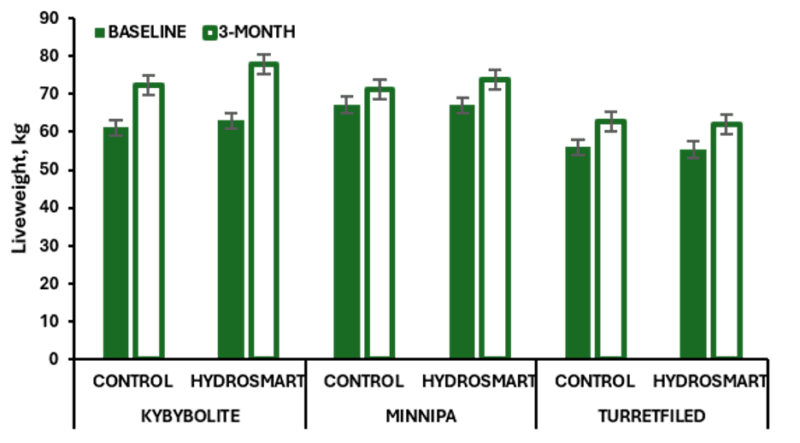
Figure 1. Liveweight changes in ewes following three months of access to either the control water or water treated using the solar-powered Hydrosmart unit
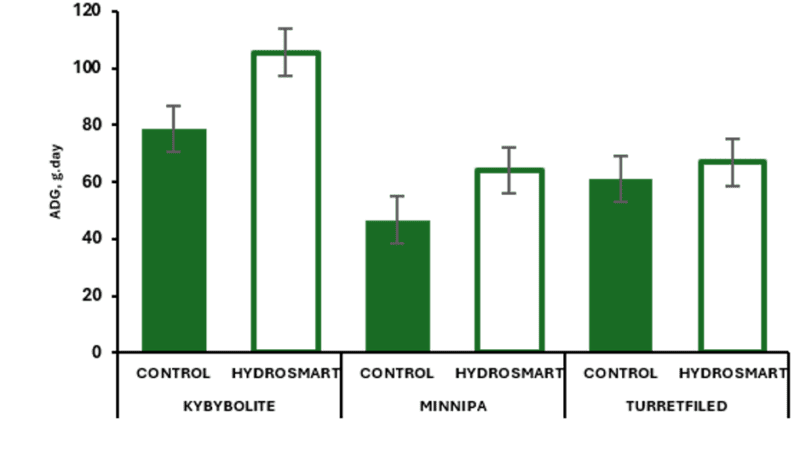
Figure 2. Average daily gain of ewes following three months of access to either the control water or water treated using the solar-powered Hydrosmart unit
Be involved as a Producer Demonstration Site
As the project transitions into Stage 2, the team is recruiting commercial sheep producers across South Australia to participate in on-farm validation trials. If you suspect water quality is holding back your stock or you are interested in trialling water conditioning technology on your property, we would love to hear from you.
Who we are looking for:
- Sheep producers in extensive grazing regions
- Farms utilising bore water with high Total Dissolved Salts (TDS > 3,000 mg/L)
- Producers interested in host sites for testing Hydrosmart conditioning units or trough aeration setups (Croc Troughs), and capturing livestock performance data
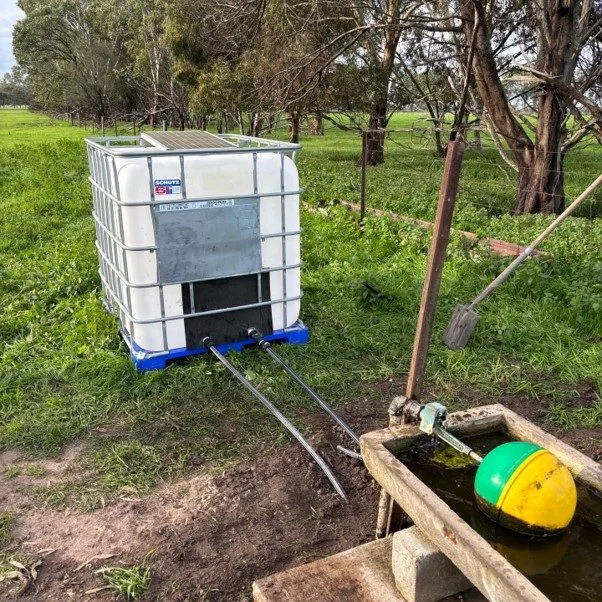
Image: Hydrosmart unit fitted to producer sheep trough
More Information:
Project Lead: Dr Alyce Lowe (SARDI / PIRSA) — [email protected]
AIR EP Contact: Rowena Norris — [email protected] | 0421 553 800
To read more about the project, visit the official SARDI project webpage:
🔗 PIRSA SARDI: Understanding the impact of water quality on sheep health
Project Acknowledgement
This project is funded by the Australian Government’s Future Drought Fund through the Long-term Trials of Drought Resilient Farming Practices Grants. The project is delivered by PIRSA through SARDI in partnership with Flinders University, Landscape SA, Hydrosmart, Agricultural Innovation & Research Eyre Peninsula (AIR EP), Barossa Improved Grazing Group (BIGG), and MacKillop Farm Management Group.

