On Row Sowing in Lentils at Wirrulla
Sowing on or near the previous year’s crop row is attracting attention as a way to improve establishment in low-rainfall no-till systems. Grower experience and trial evidence point to benefits, while the Wirrulla lentil trial is examining how the practice performs under local conditions. Achieving those benefits takes accurate guidance and disciplined harvest management.
Why growers are sowing on the row
For Ben Wudersitz, a long-time no-till grower on the Yorke Peninsula, the benefits have been substantial. “This is the biggest free kick in crop yields since we started no-till farming.”
In dry seasons, he now sows around 60% of his program on the row. In his higher-rainfall country (450–500 mm), he instead aims to sow about 20 mm off the row. Following a run of dry starts, he is seeing emergence gains across his program, including benefits from old stubble shading the row over summer.
Several factors help explain the benefits. Old root channels allow water to infiltrate the row where the undisturbed inter-row can resist it, increasing soil moisture around the seed.
Where salt is present, better infiltration can dilute or leach it away from the seed.
Some of the previous year’s fertiliser band may also remain in the old row.
The soil can be softer, particularly where a paddock has been flat-rolled over rock in a previous lentil or cereal crop.
Fewer soil clods and better seed-to-soil contact can also support establishment.
The practical challenges
Realising these gains depends on managing stubble, maintaining accurate guidance and preparing well at harvest.
Heavy residue can cause hair-pinning and blocked seed tubes, while discs and tynes behave differently over an old, partly degraded row. Finding that row consistently is also difficult. In the SAGIT research trial, a small plot seeder could not maintain consistent on-row and off-row lines, so researchers had to randomise treatments by row rather than by full replicate block.
The practice requires repeatable centimetre-level accuracy. X-Fill or RTK Extend alone can introduce around 2 cm of error, enough to miss the row. A passive lightbar system is unlikely to provide the accuracy needed; active, self-steering guidance helps maintain the line from season to season.
This usually means better RTK aerials or a grower’s own base station, together with a rear receiver or Pro tracker. Active guidance setups commonly start around $30,000, creating a significant cost hurdle for growers trying the practice for the first time.
Consistency matters too. Growers need to follow the same direction on headlands each year, keep roll/TCM calibration current and record any off-line shifts accurately. Missing a season of records makes it difficult to locate the previous rows the following year.
Sowing repeatedly on the same line can increase root disease inoculum, particularly in cereal phases, and concentrate fertiliser if placement is not managed.
Harvest management underpins the practice. A low, even cutting height and effective choppers are essential to retain the stubble row for sowing the following season.
What the trial evidence shows
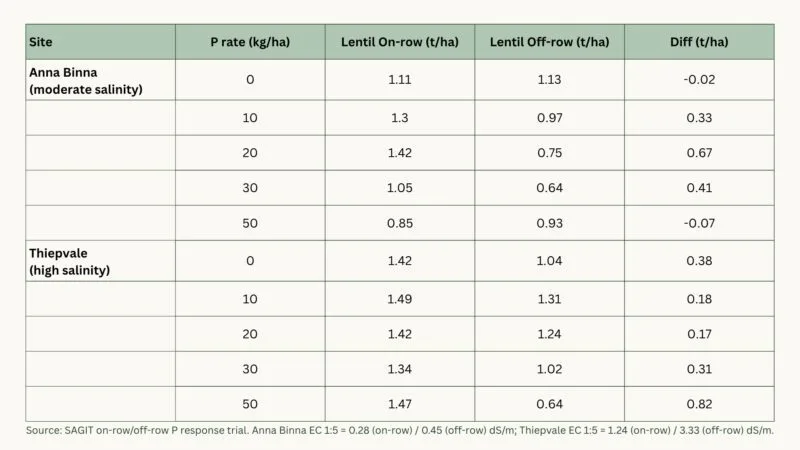
Over two seasons, SAGIT-funded replicated trials conducted by Sam Holmes on the Yorke Peninsula compared on-row and off-row sowing in lentils and barley. The trials covered five phosphorus rates applied with the seed at two salt-affected sites: Anna Binna, with moderate salinity, and Thiepvale, with high salinity.
On-row sowing lifted lentil yield at both sites. Yields ranged from 0.64 to 1.49 t/ha, a range relevant to many Wirrulla growers rather than a result confined to high-rainfall conditions.
At Anna Binna, on-row sowing increased lentil yield by 89% at the best phosphorus rate of 20 kg P/ha, producing 1.42 t/ha compared with 0.75 t/ha off-row. At that rate, it lifted partial gross margin by $836/ha, while off-row sowing went backwards.
At Thiepvale, on-row sowing lifted lentil yield at every phosphorus rate tested. At both sites, added phosphorus did little or nothing for lentils sown off-row, indicating that sowing position mattered more than fertiliser rate. Barley grown in rotation at the same sites responded even more strongly to on-row sowing.
Other published trials support these findings. GRDC-reported guidance-system trials on non-wetting soils show typical yield gains of 5–10% from on-row or edge-row sowing. CSIRO/GRDC work on water-repellent sands found that near-row sowing consistently improved establishment, achieving more than 50 plants/m² in every site-year tested, even in seasons when it did not increase yield.
Testing the approach at Wirrulla
The Wirrulla trial matches the seeder to growers’ 2025 seeding rows to compare on-row and mid-row (off-row) sowing under local conditions.
Three sowing rate treatments; Metro and Thunder at 50 kg/ha, and Thunder at 75 kg/ha, are each compared on-row and mid-row against a nil-fertiliser control. The standard Thunder rate is also tested at two phosphorus rates, examining the same relationship between sowing position and fertiliser tested in the SAGIT trial.
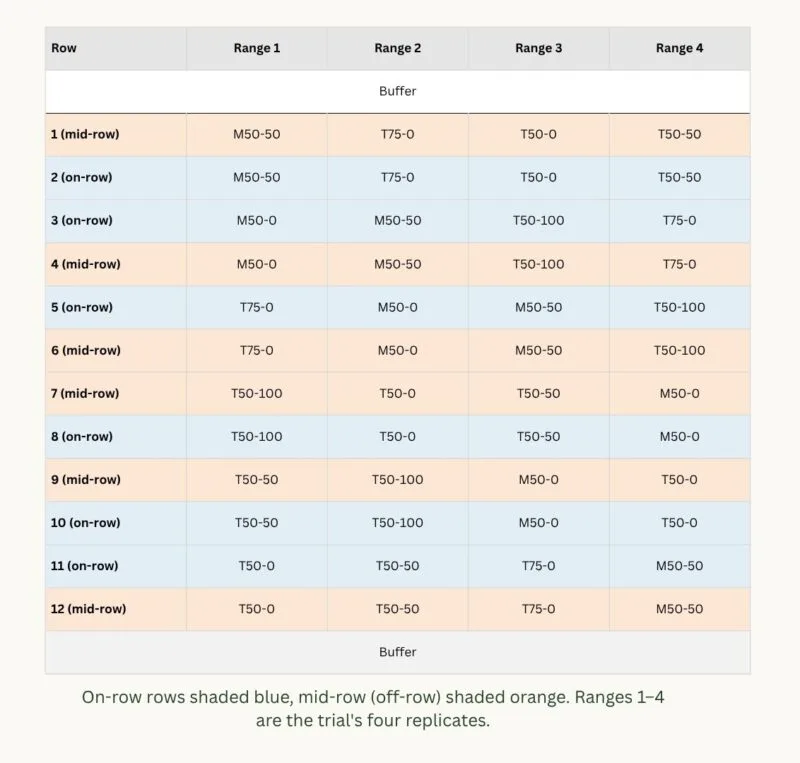
The design comprises 12 treatments replicated four times, giving 48 plots. The layout is shown below.
Codes: M50 = Metro 50kg/ha seed · T50 = Thunder 50kg/ha seed · T75 = Thunder 75kg/ha seed · –0 = nil fertiliser (Box) · –50/–100 = kg/ha MAP applied with the seed.
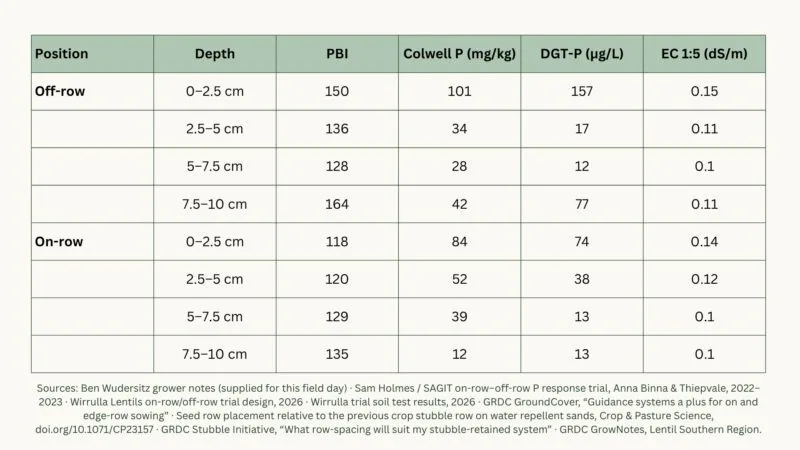
Soil test snapshot — sampled immediately post-seeding
Soil cores were sampled at Wirrulla in 2.5cm increments to 10cm depth, on-row and off-row, straight after seeding. Most P sits in the top 2.5cm regardless of position, and averaged across the full 10cm, Colwell P is similar on-row (47mg/kg) and off-row (51mg/kg), so overall P status isn't the story. The distribution through the profile is: off the row, P is concentrated in the top 2.5cm and drops away sharply; on the row it's spread more evenly through 0–7.5cm, consistent with old fertiliser bands still sitting in the row. Salinity here is low overall (EC 0.10–0.15 dS/m) and not the differentiator it was at the higher-salinity SAGIT sites. On-row sowing's value at Wirrulla this season looks more like a moisture/fertiliser-placement story than a salt-avoidance one.

This trial is part of the GRDC funded Lentils on Challenging Soils project, which is being led by AIR EP and delivered by EPAG Research. There are three other trials being conducted in 2026 as part of the project at Lock (same on row vs off row treatments as the Wirrulla trial), Verran on a sandy soil, and Coulta (calcareous soil). Check out the 2025 trial results on the project webpage.