RiskWi$e: Which farm decisions deserve five minutes – and which deserve five hours?
By Andrew Ware, EPAG Research
A practical way for growers and advisers to put more effort into the decisions that can really change the business.
Farming requires hundreds of decisions each year, but they are not all equally important. Some are familiar, relatively cheap and easy to change next season. Others commit land, labour, machinery or finance for years. The practical challenge is not to analyse everything. It is to recognise the few decisions where a little more structure - and the right people around the table - can materially improve the odds.
Some decisions matter more than others
Australian farm-management research does not identify one ranking that fits every business. But the same high-impact decisions appear repeatedly in GRDC and ABARES material: enterprise mix, land purchase or lease, machinery investment, labour and capacity, sowing and crop choice, major input decisions such as nitrogen, and long-lived soil or infrastructure investments. They differ in scale, but they can be tested with the same simple process.
How are farm decisions actually made?
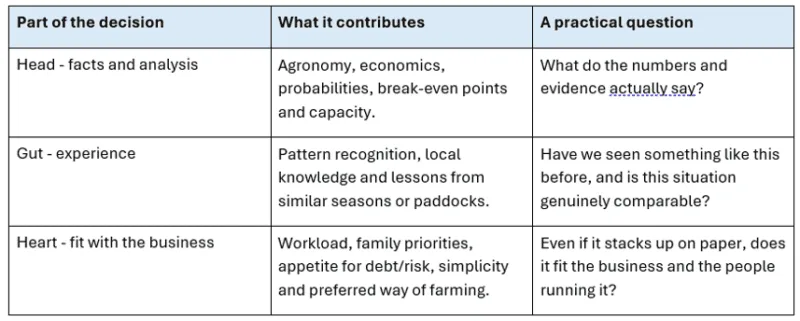
Cam Nicholson's GRDC Farm Decision Making work describes farm decisions as a mix of the 'head, heart and gut'. The head is the facts, numbers and analysis. The gut is experience and pattern recognition built over years. The heart is what matters to the people and business - workload, family, appetite for debt or risk, and the sort of farming system they actually want to run.
Brendan Brown's RiskWi$e work takes a similar practical view. Growers do not use one decision process for everything: some decisions are mainly intuitive, while others use detailed data and analysis. The useful question is not whether intuition or analysis is 'better', but whether the process matches the size, uncertainty and reversibility of the decision.
Nicholson also makes an important distinction between a good decision and a good outcome. Rainfall, markets, frost, disease and other factors can turn a sensible decision into a poor result - or make a weak decision look good. The decision is better judged by what was known at the time, the assumptions made and whether the downside was acceptable.
The practical implication
The aim is not to replace experience with spreadsheets. It is to know when experience is enough, when a quick calculation will sharpen the call, and when the decision is big enough to justify slowing down.
What the lentil/livestock shift can teach us about big decisions
The rapid shift from medic/sheep phases towards lentils on parts of Eyre Peninsula is a good example of how a sound decision can become more complicated over time. Lentil prices were very strong, livestock returns were weaker, varieties and agronomy improved, and many businesses preferred less stock work. For some farms, reducing livestock also allowed infrastructure to deteriorate or be removed, making a return to sheep increasingly expensive.
That history is useful not because growers should reverse the change, but because it shows why major decisions need to consider more than the current gross margin. Price relationships move, land classes perform differently, labour preferences matter, and some decisions gradually remove future options.
The broader lesson
Before a major change, ask: What becomes easier? What becomes harder? What new capital or labour is required? What option are we giving up? And would the decision still stack up if the price or season was less favourable than expected?
Seven decisions that regularly deserve more attention
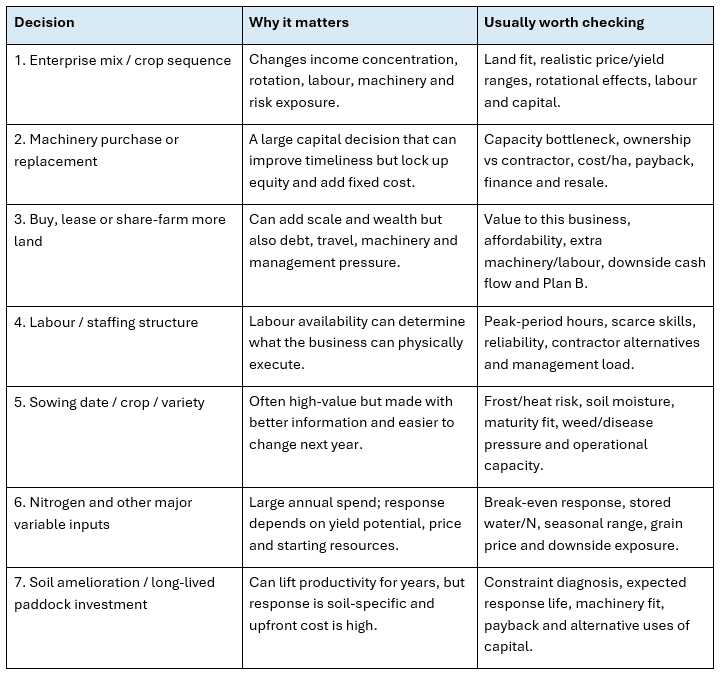
These categories are consistent with GRDC farm-management guidance, which distinguishes short-term operational decisions from medium-term complicated decisions and longer-term strategic changes. ABARES likewise identifies investment in land, infrastructure, machinery, labour and enterprise mix as major drivers of farm productivity and financial performance.
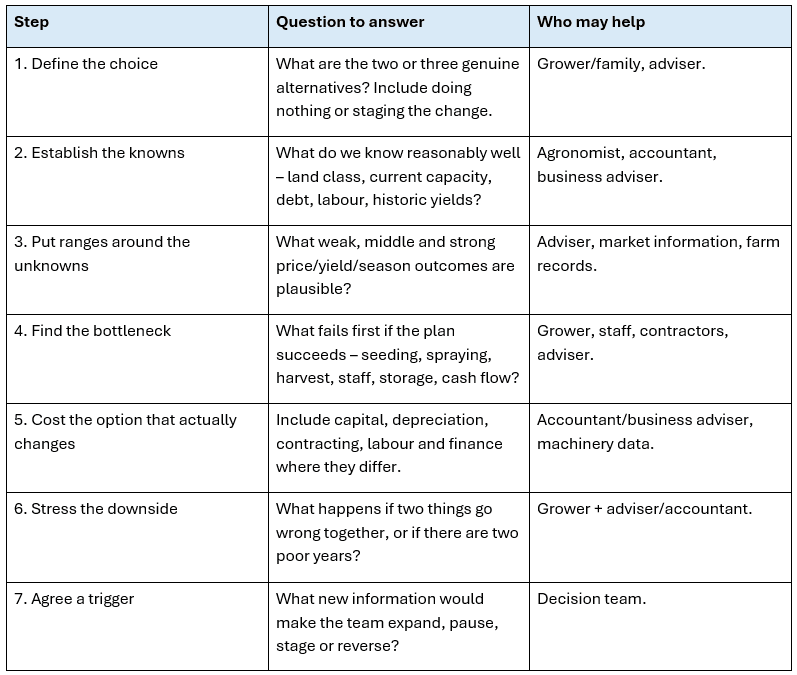
One framework can cover all of them
Worked example: buying a bigger machine
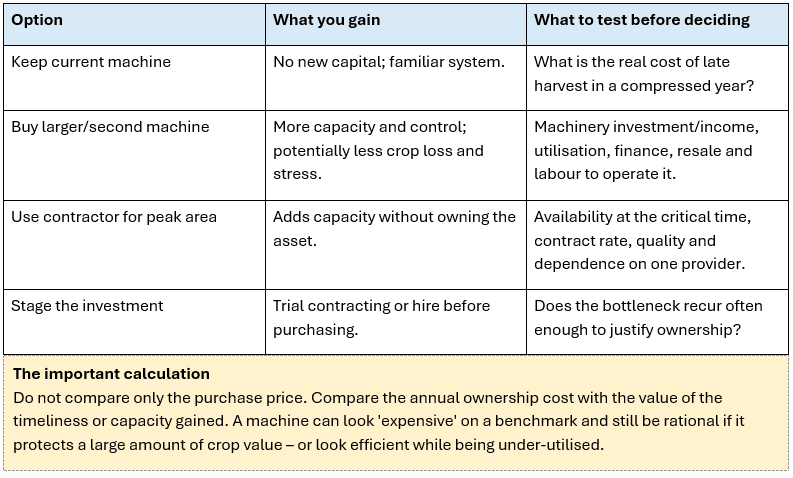
Suppose harvest capacity is becoming tight. The quick answer may be to buy a larger or second machine. GRDC machinery work highlights the trade-off: ownership can improve control and timeliness, but it ties up equity, adds repayments, depreciation and repair risk. Contractors or leasing may reduce ownership exposure but introduce availability and scheduling risk.
| The important calculation Do not compare only the purchase price. Compare the annual ownership cost with the value of the timeliness or capacity gained. A machine can look 'expensive' on a benchmark and still be rational if it protects a large amount of crop value – or look efficient while being under-utilised. |
Worked example: buying or leasing more land
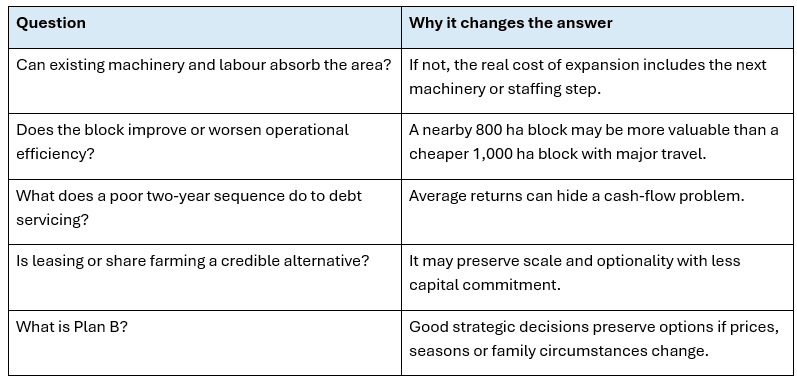
GRDC guidance on land acquisition makes an important distinction: price and value are not the same. The relevant question is what the land is worth to this particular business after allowing for extra travel, machinery, labour, finance and risk.
Worked example: nitrogen is different
Nitrogen can involve a large spend, but it is usually more reversible than buying land or machinery. GRDC farm-decision guidance uses nitrogen as a good example of a 'complicated' decision: the result depends on future rainfall, but there is useful current information such as soil water, soil N, crop potential, grain price and seasonal forecasts.
That means the decision usually deserves more than intuition, but not a five-year business model. A break-even response, realistic yield range and downside check may be enough. Recent farming-systems research also cautions against making major system changes simply because urea is temporarily expensive; long-term system ranking may not change as much as expected.
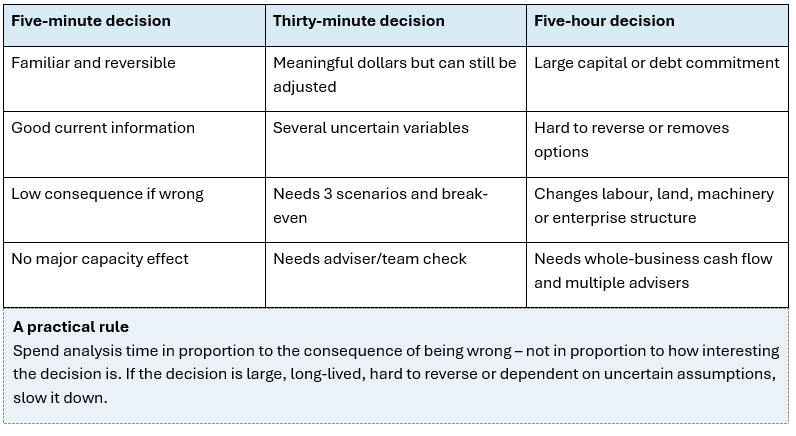
How to decide how much analysis is enough
Use the team – but give the meeting a job
Many important farm decisions are already made with agronomists, accountants, livestock advisers, staff and family. The opportunity is not necessarily to add more people. It is to make the discussion more useful.
- Send the same one-page options and assumptions to everyone before the meeting.
- Ask each adviser to identify the assumption they think is most likely to change the answer.
- Separate technical questions (will it work?) from business questions (can we afford it?) and personal constraints (do we want to operate it?).
- Where someone has a commercial interest in the sale – machinery, finance or inputs – include an independent view for large decisions.
- Finish with a decision, trigger or information gap rather than another meeting.
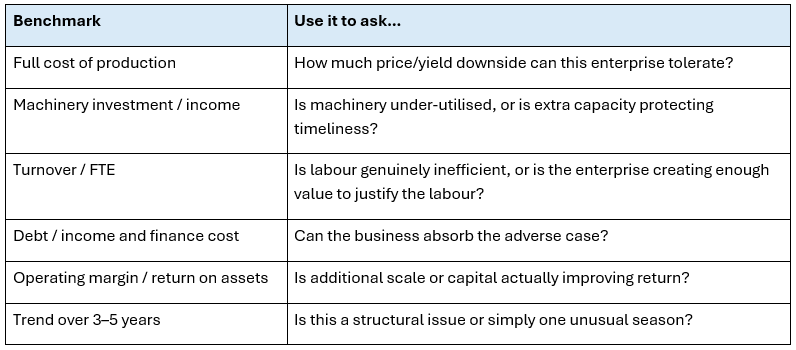
Benchmarks are most useful as warning lights
GRDC's current financial-ratio guidance recommends looking at trends over several years and stresses context – comparing like with like. The same applies to machinery and labour benchmarks.
Sources
Sources include: Cam Nicholson and co-authors, GRDC Farm Decision Making; Brendan Brown and RiskWi$e behavioural-science work on benchmarking good farm decision-making; GRDC Machinery Investment and Replacement for Australian Grain Growers; GRDC farm business and financial-ratio resources; GRDC work on land purchase/lease decisions and frost-risk management; ABARES farm investment and productivity research; 2026 SA Farm Gross Margin and Enterprise Planning Guide; EP RiskWi$e Enterprise Agronomy reporting; EPAG Research/GRDC NGN Lentils on Challenging Soils; Pinion Advisory Snapshot Profit Drivers.