
Potassium in wheat: did extra K pay its way at Ungarra in 2025?
By Brett Masters, EPAG Research
Potassium (K) is becoming a common topic of conversation for farmers and advisors across parts of Eyre Peninsula, especially on lighter sandy soils where nutrient reserves can be depleted and leaching risk is higher.
Until recently, most lower EP farmers have not routinely applied potassium fertiliser. However, recent soil testing has shown some paddocks now have surface potassium levels well below the usual marginal guide of 100 mg/kg Colwell K. Leaving many farmers to ask the question, “If soil test K is low, will applying potassium fertiliser give a reliable and economic yield response?”
To help answer that, a replicated farm-scale demonstration was run by EPAG Research at Ungarra in 2025, with support from the EP Landscape Board and the Gale family who hosted the site. The trial was established in a wheat paddock where soil testing showed low potassium levels in the sandier parts of the profile, but highly variable potassium levels deeper down depending on the depth to clay.
The paddock was sown to Matador wheat on 3 June 2025. Potassium was applied as muriate of potash at a rate equal to 75 kg/ha of potassium, using three different timings:
- before sowing
- split between pre-sowing and post-sowing
- and a later “rescue” application at tillering
A nil potassium treatment was also included for comparison.
2025 seasonal conditions made interpretation challenging for researchers. A late, dry start and water repellent surface soils caused uneven establishment, particularly in parts of the trial. However it finally rained in July, and the crop went on to produce a strong paddock average yield of about 4.08 t/ha.
Key messages for farmers
- Low soil potassium does not always mean a profitable fertiliser response. At this site, applying potassium did not produce a statistically significant grain yield increase.
- The tillering application increased crop biomass, but not final yield. Biomass at head emergence was around 20% higher where potassium was applied at tillering, but this did not carry through to a reliable grain yield benefit.
- Subsoil potassium matters. Many Eyre Peninsula duplex soils have clay layers that can contain high potassium reserves. If crop roots can access these layers, the response to applied potassium may be limited.
- Root access is the big question. Water repellence, compaction, acidity, sodicity, disease, poor early vigour or a deep sand layer can all limit root growth and reduce access to deeper potassium.
- Potassium decisions should be paddock specific. Soil testing by depth, understanding sand depth, and checking root constraints are important prior to investing in broadscale potassium applications.
What happened in the trial?
The trial compared nil potassium with potassium applied at different timings. The nil potassium treatment yielded 4.5 t/ha, and there was no significant difference in final grain yield between the nil K and K-applied treatments.
Under the conditions at Ungarra in 2025, potassium fertiliser did not generate a predictable economic yield response.
There was, however, a plant growth response in one treatment. The later tillering application produced higher biomass at head emergence, suggesting the crop may have responded visually or vegetatively to potassium at the later tillering stage. But extra biomass is only useful if it converts into extra grain — and in this case, it did not translate into a clear yield gain.
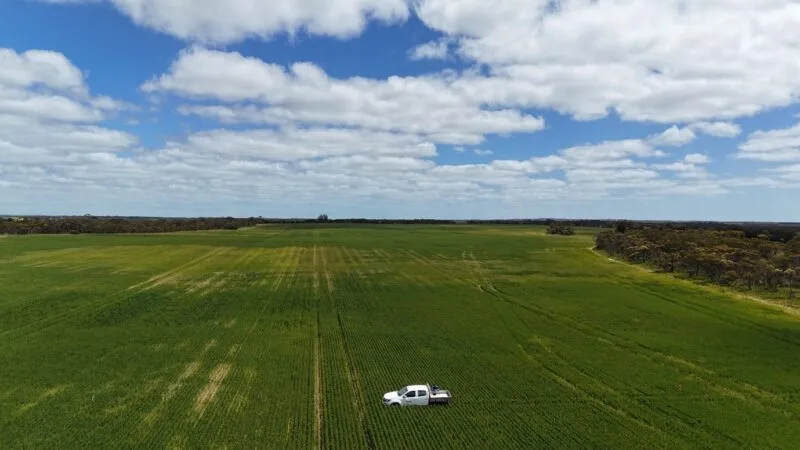
Figure 1: Aerial image of site taken in October 2025 at head emergence. Treatments were implemented at ‘farmer scale’ with K fertiliser treatments spread by hand across 12 x 30 m plots.
What does this mean on farm?
The result is a useful reminder that potassium nutrition is not just about a single topsoil test result.
On sandy rises or deeper sands, low potassium levels may still be a real issue. But on duplex soils where roots can reach potassium-rich clay, the crop may be able to draw enough K from deeper in the profile. That is especially true where early crop growth is strong and there are no major root-limiting constraints.
For growers, the practical message is to test, investigate and target rather than assume potassium will pay everywhere.
Acknowledgements
Thank you to the Gale Family for hosting and managing the site. The author also acknowledges the EP Landscape Board’s ‘Soils Extension Officer’ (funded by the South Australian Government’s Landscape Priority Fund) and Sustainable Agriculture Program (funded by the Australian Government’s Natural Heritage Trust under the Climate-Smart Agriculture Program) for supporting the establishment and monitoring of this demonstration site.
