RiskWi$e: Nitrogen decisions in a tough season
Tricky start to 2025
Grain growers across Eyre Peninsula entered the 2025 season with one of the driest starts on record. From September 2024 to May 2025, rainfall was well below average (to driest ever) across all districts. The table below highlights just how dry the start was – with January to May rainfall totals at least 50% below average for all sites.
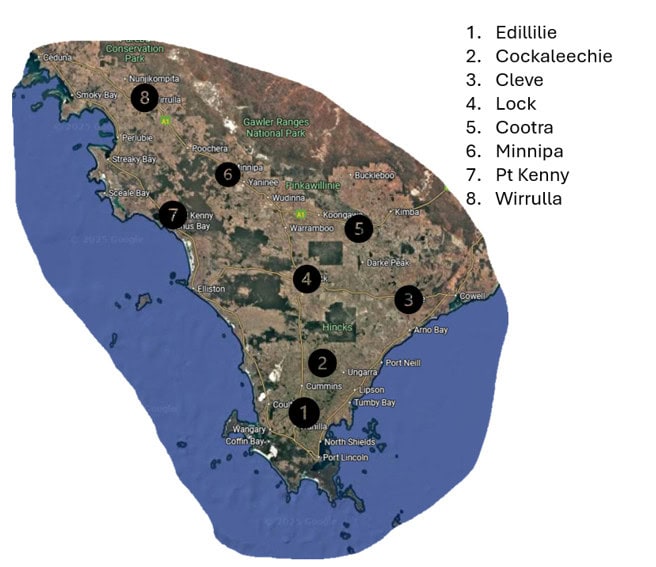
Figure 1: RiskWi$e focus paddocks in 2025
Table 1: Historical average and 2025 actual rainfall (mm) for eight locations across Eyre Peninsula.
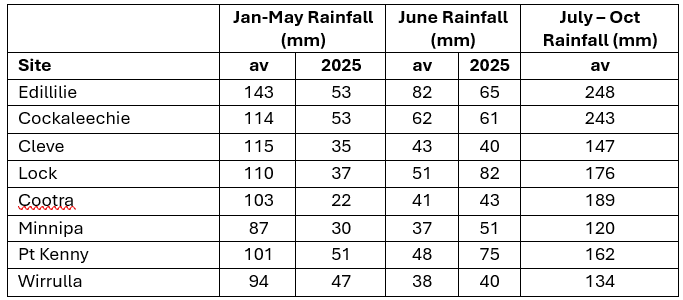
While June delivered closer to average rainfall, early crop establishment was delayed or staggered in many paddocks. Crop roots had to chase moisture, and seeding operations were sometimes adjusted to manage risk or conserve inputs.
Importantly, the July–October average rainfall figures in Table 1 provide context for what average finishing conditions might look like – and while the table doesn’t yet include the strong rains of early July, those falls have been factored into updated yield simulations below.
What yield can we still achieve?
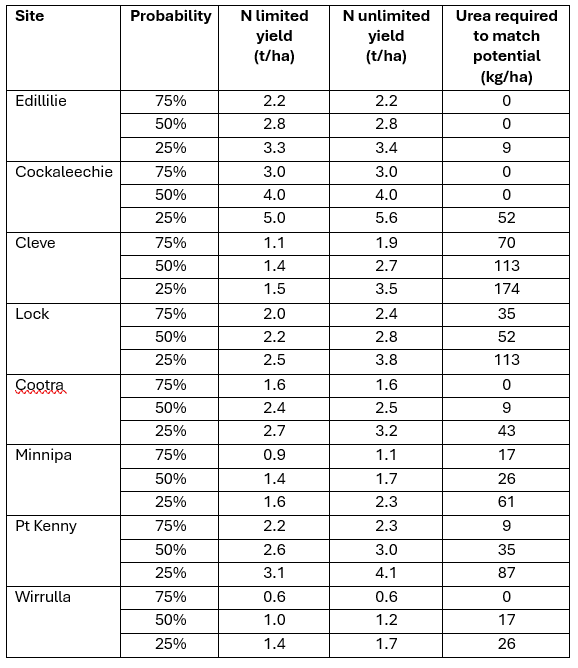
Despite the slow start, there’s still a chance to grow reasonable crops—especially if the second half of the season is kind. Current Yield Prophet simulations (Table 2) for eight EP sites reflect local soils, rainfall to date, recent good rain, and updated crop establishment timings. As an example, Figure 2 illustrates the different probabilities of yield outcomes from a certain point in a growing season, based on historical rainfall. For the purposes of this article, we are focussing on a range of probabilities of outcomes from 25% (above average rainfall from here on), 50% (average rainfall from here on) and 75% (below average rainfall from here on).
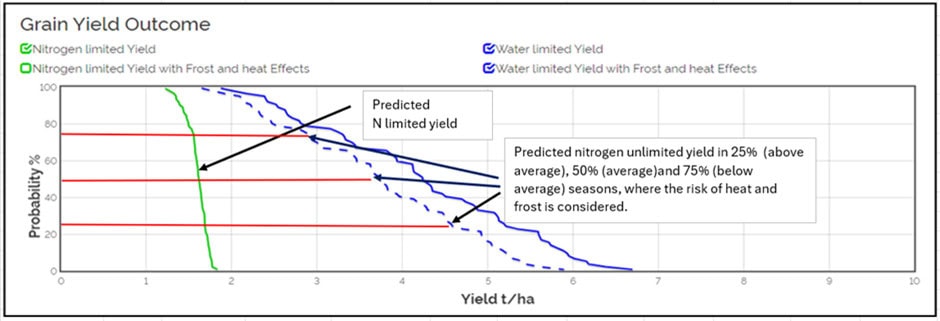
Figure 2: An example of probabilities of grain yield outcomes within a growing season, generated in Yield Prophet®.
Table 2. Yield Prophet simulated nitrogen limited and unlimited yield predictions for eight EP locations in 2025.
Key points from the simulations:
- Even after a dry start, yields of 2–3 t/ha are still possible at many sites under a 50% season scenario.
- These figures account for current stored soil moisture, and assume average seasonal finish.
- 25% probability yields reflect an above-average finish and show upside potential – particularly at Minnipa, Pt Kenny, and Lock.
- The 75% yield probabilities represent seasons that are drier than average – a guide to drier than average seasonal outcomes from this point forward.
- It should be noted that all predicted yields (high, low and average) are all still possible and planning should be used to incorporate this range of potential outcomes.
Nitrogen: still worth thinking about
Once potential yield is estimated, growers can consider whether the crop has enough nitrogen to achieve it. A general rule of thumb is:
1 t/ha of wheat requires ~40 kg of nitrogen (N).
Some of this N will come from the soil (as mineral N) or starter fertiliser. What’s important is the gap between current N supply and crop demand. Yield Prophet has worked through these calculations.
Key takeaways:
- At sites like Cleve, Cootra, Minnipa, and Pt Kenny, urea applications of 35–113 kg/ha may still deliver a return.
- At Edillilie, the soils used in simulations have poor water-holding capacity—so even with relatively high rainfall, yield potential remains modest.
- The soils at Edillilie and Cockaleechie had high levels of mineral N, measured in the soil prior to sowing, reducing the need for further N applications to the 2025 crop.
- Even in this season, targeted nitrogen applications may be worthwhile, especially if growers are chasing 2+ t/ha crops.
Weighing the Opportunity vs Risk
While there are upside opportunities, growers and advisors need to weigh:
- Cash flow limitations—is there room to invest further?
- Urea availability—logistics are tight in many areas.
- Seasonal outlook—while BOM suggests a wetter-than-average finish is more likely, the confidence in that forecast remains low.
It’s not an easy decision—but it’s not a write-off either.
Next steps
AIR EP and EPAG Research are continuing to work with focus paddock growers to monitor crop growth, rainfall, and nitrogen decisions. We’ll continue to share insights to support tactical in-season choices.
Growers and advisors are encouraged to:
- Revisit soil test results and starter N rates
- Use Yield Prophet or other simulation tools to estimate remaining crop potential
- Consider N top-ups where profitable returns are possible and logistics allow
For more information or help interpreting your own paddock data, contact the AIR EP team.
Article prepared by Andrew Ware, EPAG Research as part of the GRDC funded RiskWi$e project.
To check out the latest Yield Prophet reports generated on 10 July 2025 for the EP focus paddocks, go to the RiskWi$e project page on the AIR EP website.