RiskWi$e: The crop has built the canopy. What is still worth backing?
By Andrew Ware, EPAG Research
A strong start created genuine upside. Still largely full soil moisture profiles but with drawdown starting to occur, rapid crop development and tight cash flow now shift the RiskWi$e question from how hard to chase yield to how best to protect profit.
Across EP, crops are carrying more promise into late winter than many growers would have dared budget for at sowing. Strong canopies, rapid development and still-useful soil moisture reserves create plenty of reason for optimism, but they are also bringing the next round of decisions into focus. How much yield is now realistic? Is flowering still likely to fall in the right window? Which fungicide or insecticide applications can genuinely protect profit? And are harvest, storage and marketing plans ready if the season delivers? This newsletter draws together local observations, Yield Prophet results, soil-moisture probe data and findings from the Lock Profitable Yield Frontiers trial to explore those questions.
The excellent start has built large canopies, but the past few weeks have been drier, frost has remained in the mix and the immediate rainfall outlook is modest. Some paddocks have also carried the legacy of waterlogging, leaching or uneven nitrogen supply. The result is a season with substantial upside, but not a uniform one.
For most businesses, the nitrogen program is now largely complete. A late application would need both suitable rain and enough remaining yield response to justify the cash and seasonal risk. The more useful decisions are now to reset yield expectations, prepare for harvest and grain marketing, and decide which remaining crop-protection inputs can credibly protect margin.
What the focus paddocks are saying
The 27 July Yield Prophet® reports show that the same favourable opening has produced very different combinations of canopy size, remaining water and flowering exposure across EP.
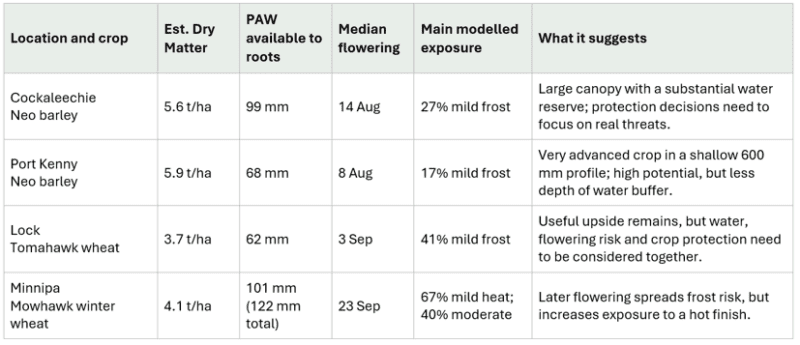
These are not four versions of the same good season. They are four different risk positions. Yield potential is useful, but the next decision should be based on the paddock’s biomass, rooting depth, remaining water, flowering timing and the probability that another dollar of input can still become grain.
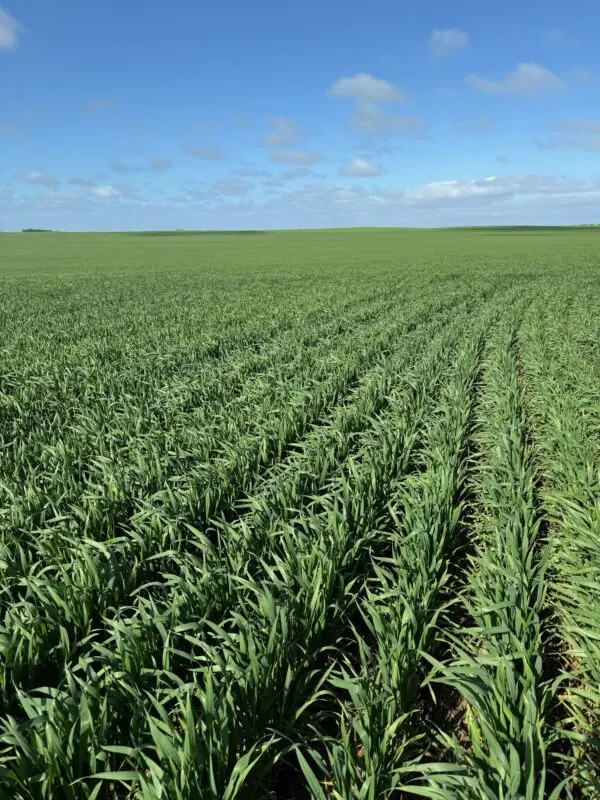
Above: The Lock focus paddock on 28 July 2026. Photo: Jake Giles, EPAG Research.
The Lock probe shows the water bank is being used
At Lock, Yield Prophet estimates 62 mm of plant-available water remaining. The soil moisture probe provides an independent, point-scale view of the same seasonal shift. Large June rainfall events lifted the summed soil moisture in the profile to its seasonal peak. By late July it had declined to about by around 28% of plant available water, despite several smaller rainfall events.
The profile at the probe location remains well above the historical extraction limits measured under previous wheat and vetch crops. There is still moisture in the bank, but the crop has started making regular withdrawals.
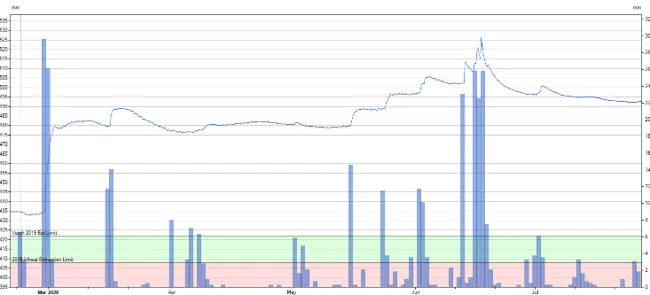
Figure 1. Summed soil moisture and rainfall at the Lock focus paddock. June rainfall recharged the monitored profile, but the summed reading has since declined as crop demand increased. The absolute sensor value is not directly equivalent to Yield Prophet predicted plant-available water.
The individual sensor traces help show where that change is occurring. The clearest and most consistent drying signal is through the upper 10-50 cm of the profile. The 60 cm trace is also changing, but its recent upward movement is more consistent with redistribution, recharge or a sensor response than straightforward extraction. It should not be used alone to claim active crop water use at that depth. The deeper 70-100 cm traces have changed less over this short period.
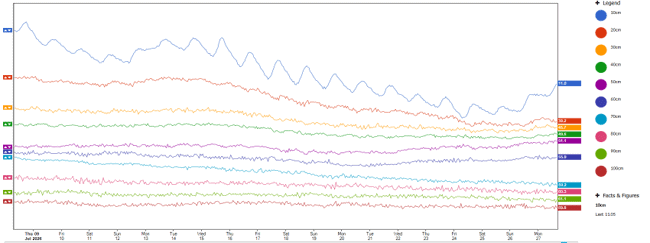
Figure 2. Lock soil moisture sensor traces at 10 cm increments. The strongest drying response is visible through the upper half metre. Interpretation of individual traces should allow for sensor calibration, soil-layer differences and redistribution after rain.
The important point is not whether the roots have reached an exact depth on a particular day. It is that a large canopy is already using water from a meaningful part of the profile, while the value of deeper moisture will depend on root access, soil constraints and how much rain arrives through August and spring.
How much finish does the canopy need?
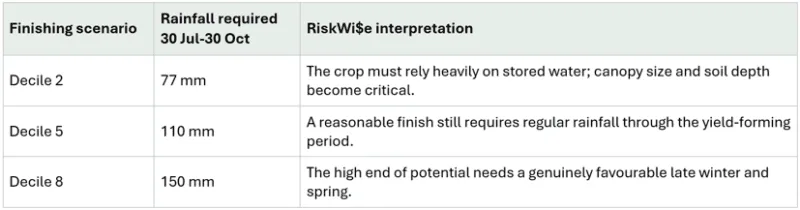
Kenton Porker’s analysis of the Lock Profitable Yield Frontiers site places useful numbers around the remaining uncertainty. The following scenarios are not forecasts; they show the rainfall required from 30 July to 30 October to achieve different seasonal finishes.
A useful thought experiment is that a large cereal canopy may use around 3 mm of water per day during August. Across the month, that is roughly 93 mm of potential crop water use. Rainfall will meet some of that demand and actual use will vary with weather and canopy condition, but the calculation explains why a wet July profile can begin to decline quickly.
High biomass is therefore not banked yield. The crop still has to carry that canopy through the critical period, set grain number and then convert biomass into grain. This is where soil depth, rooting, nitrogen already in the system and the seasonal finish all meet.
Rapid development makes phenology a risk-spreading tool
Crop development has been rapid this year. Warmer-than-normal thermal time can move quick-to-mid spring wheats such as Scepter, Tomahawk and Shotgun through development faster than growers expect from the sowing date alone. At Lock, the broad target is flag-leaf emergence through early to mid-August and flowering around early September, while recognising that seasonal temperature can shift the calendar.
What Yield Prophet is indicating about the seasonal water opportunity
The updated Yield Prophet runs reinforce that the same strong start is producing quite different water-limited yield prospects, and different levels of uncertainty, across EP. The midpoint of each probability curve (50% probability) is useful, but so is its width: the lower end reflects poorer historical finishes, while the upper tail shows what may be possible if late-winter and spring conditions remain favourable.
The two barley paddocks currently carry the highest water-limited potential. At Cockaleechie, outcomes extend from roughly the high-7 t/ha range under poorer finishes to above 9 t/ha under favourable finishes. Port Kenny shows a similarly strong outlook, with much of the probability range sitting around 8–9 t/ha and some further upside if the finish remains favourable.
At Lock, Tomahawk wheat has a broader spread of water-limited outcomes, from approximately the mid-3 t/ha range under a poorer finish to around 6 t/ha or more under favourable conditions. This wide distribution highlights how much of the final outcome still depends on late-winter and spring rainfall. It also aligns with the Profitable Yield Frontiers analysis, which describes distinctly different finishing scenarios based on receiving around 77, 110 or 150 mm from late July to the end of October.
The early-sown winter wheat at Minnipa also shows substantial seasonal upside. Water-limited outcomes extend from roughly the mid-4 t/ha range under a poorer finish to above 6 t/ha under more favourable conditions. Its later flowering reduces frost exposure, but means the upper end of the yield range remains more exposed to heat and moisture stress during grain fill.
These distributions show why a promising start does not translate into the same level of certainty everywhere. Some paddocks retain a relatively narrow range of outcomes, while others could still move considerably depending on spring rainfall, temperature and the timing of any frost or heat events. This is why Yield Prophet is most useful for developing downside, working and upside estimates, rather than treating a single yield figure as locked in.
Planning around a range, not a single yield
As crops move through stem elongation and towards flowering, attention is naturally shifting from crop establishment and nitrogen decisions to target yields, grain marketing and harvest logistics. A single yield estimate is unlikely to serve every decision equally well, so it may be more useful to use a range of yield predictions to cater for multiple outcomes for each paddock or management zone.
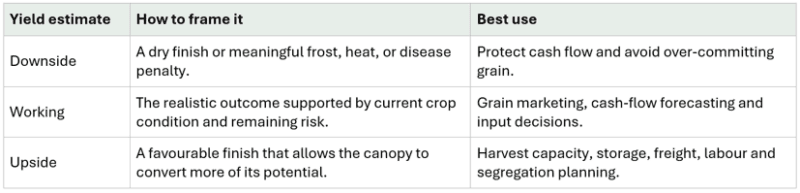
The upside estimate is particularly useful for logistics. How many tonnes can the header reap per hour? How quickly can grain be shifted off farm? Is there enough on-farm storage, or a safe contingency for temporary storage? Are the intended transport routes and roads suitable for the expected task? In a potentially large season, these are not questions to leave until October.
Protecting potential—or simply adding cost?
Strong crop potential has increased interest in fungicide and insecticide applications. That is understandable, but the risk cuts both ways. Missing a timely fungicide in a high-risk pulse crop may allow disease to establish before it can be effectively contained. Spraying a low-risk crop without a credible disease or pest threat may add substantial cost without protecting any yield.
The distinction is not simply between “preventative” and “reactive” spraying. It is between a risk-based protective application and an application made mainly because the crop looks valuable.
Pulse crops deserve particular consideration. Many pulse fungicides provide their best protection when applied before infection, rainfall or canopy closure. A susceptible variety, infected stubble nearby, early disease, a dense canopy and forecast wet or humid conditions may justify treatment before widespread symptoms are visible. Once disease is established deep within a closed canopy, application coverage and epidemic control can become much more difficult. Where those risk factors are absent and dry weather is forecast, monitoring may be the better investment.
Cereal fungicide decisions can often be more responsive to what is happening in the paddock. Regular monitoring, current variety resistance ratings, crop stage, disease presence and likely rainfall should guide whether the upper canopy needs protection. Rusts can still develop rapidly in susceptible varieties, so early treatment at the start of an epidemic may be essential. However, in EP’s low- and medium-rainfall environments, routine fungicide applications without sufficient disease pressure or finishing potential may not recover their cost. The aim is to protect the flag leaf and other yield-forming leaves when a credible threat exists, rather than automatically treating every high-potential cereal crop.
For insecticides, the starting point should remain correct pest identification, crop stage, pest numbers, economic thresholds and the presence of beneficial insects. Spraying without a damaging population may provide no return while removing predators and parasitoids that were helping to suppress the pest. Where treatment is justified, product choice should consider effectiveness, resistance management and impacts on beneficials.
Before the next pass, ask:
- Is there a credible disease or pest threat, even if symptoms are not yet widespread?
- Does variety susceptibility, paddock history, canopy condition and forecast weather support rapid development?
- Do my logistics allow me to cover the area needed in a timely manner?
- Is this a protectant treatment that must be applied before the next infection period?
- For insects, are numbers approaching an economic threshold, and what beneficials are present?
- Will the timing, product, water rate and application quality provide effective coverage?
Look beyond the cost per hectare
Calculating the break-even yield protected remains useful, but it can make a large enterprise decision appear deceptively small. At a net grain value of $350/t, a $40/ha treatment needs to protect about 0.11 t/ha. Yet the same pass across 1,000 hectares is a $40,000 commitment in a year when cash flow and margins may already be tight.
Both scales matter. The per-hectare calculation tests whether a realistic yield loss can be prevented. The whole-enterprise calculation asks how much cash is being committed, how confident the business is of receiving a return, and whether every hectare carries the same risk.
The objective is neither blanket prevention nor minimum pesticide use. It is to act early where the biology demands it, hold back where the threat is weak, and make every application earn its place in the paddock and the business.
The take-home
The early season created real opportunity, but the next phase is about conversion rather than appearance. Large canopies are now using the moisture that supported their establishment, crops are moving rapidly through development and the remaining finish will determine how much potential becomes grain.
For most growers, that means keeping the nitrogen spreader parked, updating yield ranges, checking where the water and roots actually are, and being selective with crop protection. It also means using species, variety and sowing-date diversity to avoid placing the whole program in one flowering window, and planning harvest logistics against the upside case before it arrives.
The most profitable decision may still be to keep investing in the best-looking crop—particularly where yield potential, soil moisture, crop health and the threat being managed all support that choice. But a strong crop is not, by itself, enough reason to spend. A decision that matches each investment to the yield genuinely at risk, directs money to the hectares most likely to return it, and retains enough flexibility to respond to the finish that actually unfolds may prove more profitable.
The latest Yield Prophet reports have been generated for Lock, Cootra, Cockaleechie, Edillilie, Minnipa and Port Kenny. To view the reports, visit the AIR EP RiskWi$e project page: https://airep.com.au/research/riskwise-national-risk-management-initiative-action-research-groups-eyre-peninsula/
Sources and acknowledgements
- Yield Prophet crop reports for Cockaleechie, Port Kenny, Lock and Minnipa, dated 27 July 2026.
- Kenton Porker, CSIRO. Lock crop development and yield potential: Profitable Yield Frontiers notes and 2025 experimental summary.
- AIR EP. RiskWi$e EP Event Reflection – Minnipa Discussion Group, 24 July 2026.
- Lock focus paddock GMH soil moisture probe outputs: summed profile and individual sensors at 10 cm increments.
- RiskWi$e EP newsletter, 30 June 2026.
- General crop-protection principles should be checked against current GRDC guidance, product labels and local adviser recommendations.