
De-risking the seeding program 2024
Project Partners
Ag Excellence Alliance & SARDI
Further Resources
Check out this case study demonstrating two different approaches taken by EP farming businesses to overcome the impact of fertiliser toxicity on seed germination and emergence in dry sowing situations.
You can explore the practices trialled by other farming systems groups on the project lead AgExcellence Website
Aim of the project
Adoption of key management practices for the success of dry early sown crops. On Eyre Peninsula, trials comparing fertiliser placement, use of long coleoptile varieties. will be sown at two locations on northern Eyre Peninsula. These will follow on from trials conducted under the SA Drought Hub early sowing project at Cowell and Penong.
Project Summary
Dry and early sowing of cereal crops is a practice commonly employed across southern Australian cropping regions to combat the increasingly erratic and delayed opening season rainfall. Whilst there has been a large amount of research and development undertaken on dry and early sowing, significant opportunities remain to engage growers in the adoption of strategic management approaches that best suit local grower needs, management preferences, and local climatic and environmental conditions. This project will see fifteen prominent Grower Groups partner with 4 Drought Hubs to deliver a program that accelerates the adoption of strategic dry and early sown crop management approaches. Each group will tailor activities to meet the knowledge, experience, and needs of their member bases and local communities. The project will provide a legacy through developed extension networks, resources, information, and learning groups and see practice adoption across two million hectares of arable land.
2024 Trial Summary – Upper Eyre Peninsula
The season began dry, with significant rainfall finally arriving on May 30 and again from June 18–26. This rainfall event consisted of continuous showers. Most upper EP locations received over 15 mm of rainfall by the 26th June. Two trials investigating pre-emergent herbicide damage under early/dry sowing were planned at Rudall and Elliston. The Elliston site was destroyed by Cape Barren Geese and resown at Port Kenny on May 22.
Trial Sites & Sowing Dates
- Rudall: Sown 18 April
- Port Kenny (replacing Elliston): Sown 22 May
Trial Focus
Testing herbicide effects at two sowing depths (3–4 cm vs. 8 cm) using Calibre wheat and a range of IBS herbicide treatments including Trifluralin, Sakura, Overwatch, Boxer Gold, Mateno Complete, Diuron, and Metribuzin.
Key Notes
- Deep seeding reduced crop establishment but did not cause any yield penalties at two sites compared toshallow sown crops.
- Yields were the same for all early season grass weed control herbicide treatments. This is likely due to water availability being more if a prominent factor influencing grain yield in the dry conditions of 2024
- Elliston trial data is void due to grazing damage.
- Conditions remained dry throughout the season (Decile 1 rainfall).
- Trial results were presented during the Mt Cooper Ag Bureau Sticky Beak Day (Oct 1).
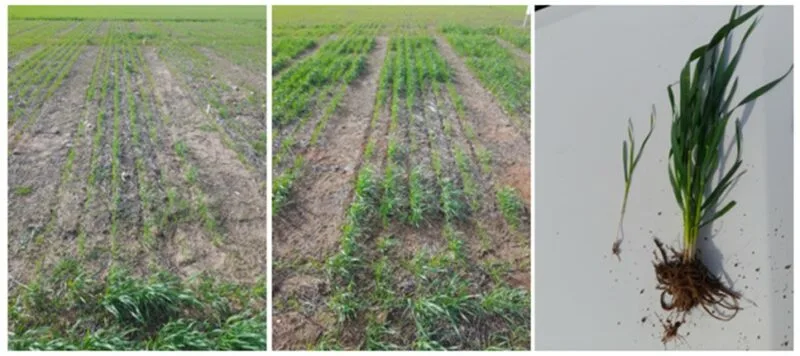
Plant establishment of shallow sown crop (Left), deep sown crop (middle) and the comparison of Zadoks growth stage of crops from the same deep sown plot (Right) at Rudall, 2024.
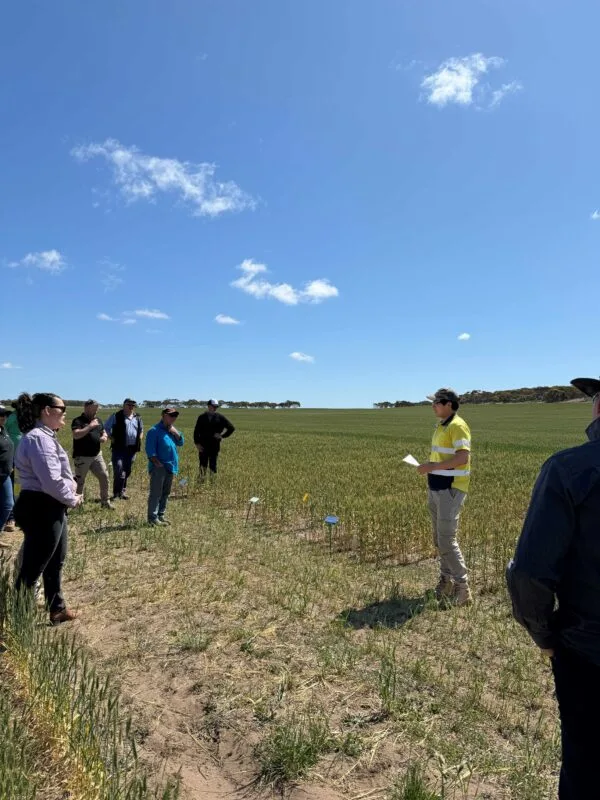
Elijah Luo (SARDI MAC) presenting at the Port Kenny De-Risking the Seeding Program Trial Site on 1 October 2024.

This page was last updated on 16 December 2025.
Share this project:
You Might Also Like
On-Farm Weather Stations & Moisture Probe adoption
Expanding the reach and promotion of “Web Wednesday” by involving additional groups across a wider geographic area. Providing access to existing weather station set-up, maintenance & calibration resources, either via…
Far West Young Farmers – Drought Resilient Decision Making & Peer Learning Network
This project will support young farmers (18 to 35 years of age) in building resilience and improving decision-making in response to drought and seasonal variability. Through a series of peer-to-peer…
Water quality in extensive sheep grazing systems
Water quality factors such as total dissolvable salts, temperature, mineral composition, pH, and microbial load can differ between their sources. Further, run off from pasture herbicides and fertilisers may be…
Review of target values for soil performance indicators and their interdependencies
Complete a survey provided by Federation University identifying key factors and existing resources to support project implementation. This will include: • Identification and sharing of existing interpretation tables and assessments…
Eyre Peninsula internship in applied grains research 2027 (SA Drought Hub Contribution)
SA Drought Hub contribution towards grains research intern on EP for 2027, to be hosted by EPAG Research. This page was last updated on 17 June 2026.
Derisking the sowing program on EP – a comparison of different seeding systems and crops in 2026
The Minnipa Agricultural Centre operates two broadacre seeding systems. One is a tyne-based Horwood Bagshaw Precision Seeding System (PSS), the other is a RootBoot Razor, single disc hybrid system. The…
Eyre Peninsula internship in applied grains research 2027
To improve the capacity of grains research, development and extension in the Eyre Peninsula region through the employment of an annual intern within local research organisations in 2027. To further…
Soil CRC Adoption Activities
Soil CRC presentations at current group event Sandy Soils Amelioration day/half day with CSIRO Soil CRC presentations at current group event – MAC Field Day This page was last…
Plan 2 Profit upper EP 2026
Targeted at younger farmers on upper EP, this project aims to train a minimum of 10 farm businesses to: – Improve farm business financial literacy – Set goals and develop…
Risky Business Workshops for EP 2026
The “Risky Business” game to be delivered in person at 3 locations on EP, tentatively Wudinna, Rudall and Wirrulla (TBC). Up to 30 participants per workshop. Aim of improving understanding…