
Robust ground cover to enable resilient low rainfall mixed farms
Summary
Seed priming (SARDI Minnipa Agricultural Centre)
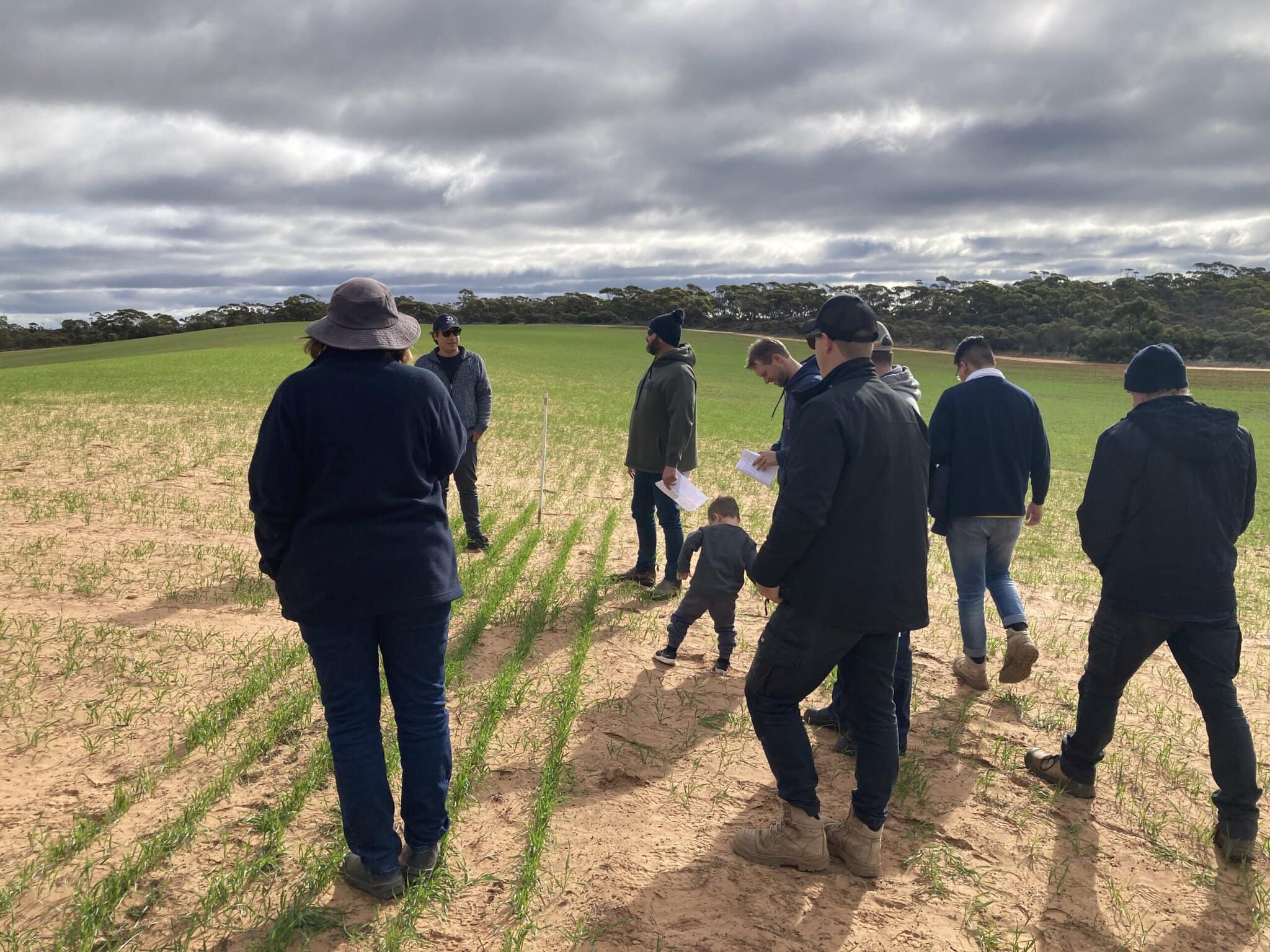
Small plot trial and larger scale farmer demonstrations north of Minnipa were harvested on 15 November 2023 for grain yield and quality assessment. In 2023, there were no differences in wheat grain yield with seeding position, seed priming or soil wetter compared to the control, with the trial averaging 0.86 t/ha. The 2023 growing season was a Decile 2 with a dry winter and dry spring, which limited grain fill. Grain protein, screenings, test weight and 1000-grain weight were not affected by seeding position, seed priming or soil wetter compared to the control.
SUMMARY OF FINDINGS
- Seeding into the soil moisture zone either shallow (2023) or deeper with a long coleoptile variety (2022 and 2023) can best maximise plant establishment and stubble groundcover in non-wetting sandy soil conditions.
- In 2022, deeper seeding improved wheat crop establishment and early/late development. While no grain yield benefits were detected in 2022, deeper sowing increased both protein content and grain size.
- Seed priming showed some potential to improve wheat seed germination under laboratory conditions, but it did not improve plant establishment under field conditions in 2022 and 2023.
- Soil wetter on a non-wetting sandy soil resulted in a small improvement in wheat crop establishment and early vigour in 2022.
The methods, results and discussion of trials and demonstrations conducted are described in the article: Developing robust groundcover to promote resilience in low rainfall mixed farms using seed priming. Eyre Peninsula Farming Systems Summary 2023.
Long coleoptile (EPAG Research)
This trial and the adjacent GRDC trial suggest that long coleoptile genetics can be used to aid crop emergence if sowing very deep to chase moisture. These results concur with those from Cootra in 2022 (EPFS Summary 2022, p. 92-94) which demonstrated that in years where surface soils are dry, but there is moisture at depth, cultivars with long coleoptile genetics were able to establish better from deeper sowing.
Results from Wharminda in 2023 also suggested that if there is soil moisture below the traditional seeding depth, current commercial varieties which are grown locally have the capacity to emerge from 6-8 cm with little establishment penalty. Whilst this has improved landholder confidence to sow to 8 cm, plant numbers at establishment were much lower when these varieties were sown deeper than that and growth penalties should be expected if targeting seeding that deep
SUMMARY OF FINDINGS
- Long coleoptile wheat can permit deep sowing to access soil moisture.
- When opportunities arise, it might be possible to use a range of currently available, shorter coleoptile, high yielding genetics sown deeper (6-8 cm) into moisture with only minor establishment and yield penalties.
- When sowing deep, good quality seed is important for emergence due to increased reliance on seed reserves and it is recommended that seed intended to be used for deep sowing has high germination and vigour, not affected by weather damage prior to harvest.
The methods, results and discussion of trials and demonstrations conducted are described in the article: Did long coleoptile wheat varieties have a role for developing robust ground cover on sandy soils at Wharminda in 2023? Eyre Peninsula Farming Systems Summary 2023.
This page was last updated on 31 October 2024.
Downloads:
Share this project:
You Might Also Like
On-Farm Weather Stations & Moisture Probe adoption
Expanding the reach and promotion of “Web Wednesday” by involving additional groups across a wider geographic area. Providing access to existing weather station set-up, maintenance & calibration resources, either via…
Far West Young Farmers – Drought Resilient Decision Making & Peer Learning Network
This project will support young farmers (18 to 35 years of age) in building resilience and improving decision-making in response to drought and seasonal variability. Through a series of peer-to-peer…
Water quality in extensive sheep grazing systems
Water quality factors such as total dissolvable salts, temperature, mineral composition, pH, and microbial load can differ between their sources. Further, run off from pasture herbicides and fertilisers may be…
Review of target values for soil performance indicators and their interdependencies
Complete a survey provided by Federation University identifying key factors and existing resources to support project implementation. This will include: • Identification and sharing of existing interpretation tables and assessments…
Eyre Peninsula internship in applied grains research 2027 (SA Drought Hub Contribution)
SA Drought Hub contribution towards grains research intern on EP for 2027, to be hosted by EPAG Research. This page was last updated on 17 June 2026.
Derisking the sowing program on EP – a comparison of different seeding systems and crops in 2026
The Minnipa Agricultural Centre operates two broadacre seeding systems. One is a tyne-based Horwood Bagshaw Precision Seeding System (PSS), the other is a RootBoot Razor, single disc hybrid system. The…
Eyre Peninsula internship in applied grains research 2027
To improve the capacity of grains research, development and extension in the Eyre Peninsula region through the employment of an annual intern within local research organisations in 2027. To further…
Soil CRC Adoption Activities
Soil CRC presentations at current group event Sandy Soils Amelioration day/half day with CSIRO Soil CRC presentations at current group event – MAC Field Day This page was last…
Plan 2 Profit upper EP 2026
Targeted at younger farmers on upper EP, this project aims to train a minimum of 10 farm businesses to: – Improve farm business financial literacy – Set goals and develop…
Risky Business Workshops for EP 2026
The “Risky Business” game to be delivered in person at 3 locations on EP, tentatively Wudinna, Rudall and Wirrulla (TBC). Up to 30 participants per workshop. Aim of improving understanding…