What was behind poor pulse growth on Lower Eyre Peninsula in 2025?
Paddock investigations from the 2025 season
By Brett Masters and Andrew Ware, EPAG Research
In some Lower Eyre Peninsula pulse paddocks in 2025, the difference between the good and poor areas was dramatic.
In the lentil paddocks investigated, the better parts of the paddock produced more than 7.5 times the spring biomass of the poor patches. In the faba bean paddocks, the better areas produced more than double the biomass of the poorer areas.
These differences were not just cosmetic. They represented large production gaps within the same paddock, often only a short distance apart.
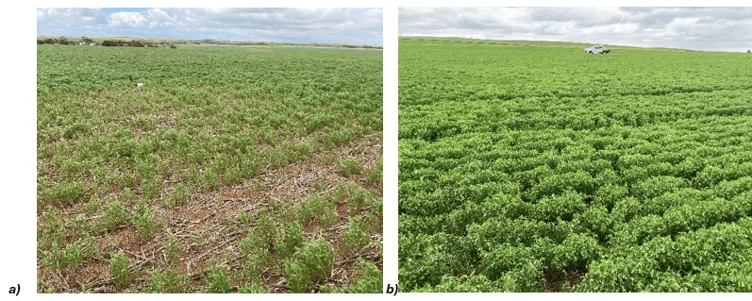
Lentil growth at site JH, Cockaleechie on the poor (a) and good (b) growth areas
The obvious question was: why?
At first glance, the poor areas looked like a waterlogging problem. The season started with very dry soil profiles, but June rainfall improved and July was wet. Some paddocks had short-term surface waterlogging, particularly in lower-lying or slower-draining areas.
However, the paddock investigations showed that waterlogging was only part of the story. In many cases, the wet conditions appeared to expose or worsen soil constraints that were already present.
Seven paddocks were investigated during spring 2025. These included four lentil paddocks around Cummins, Cockaleechie and Yeelanna, and three paddocks south of Cummins at Edillilie, Wangary and Louth Bay. Each paddock had areas of poor crop growth compared with nearby areas of better growth.
Soil samples, plant tissue tests, biomass cuts, root observations and satellite NDVI imagery were used to compare the poor and good growth areas.
What the season did
The 2025 season started dry. Summer and autumn rainfall were well below average, and many Lower EP soil profiles had very little stored water going into winter.
Rainfall improved in June, followed by a wet July. At Cummins, July rainfall was above the long-term average, and this caused short-term surface waterlogging in parts of some paddocks.
In many areas, this waterlogging was temporary. However, in some lentil and faba bean crops, patches of poor growth continued well into spring. This suggested that the wet conditions had interacted with something else in the soil.
The worst affected patches generally had one or more underlying soil constraints, including:
- shallow dispersive clay layers
- poor internal drainage
- elevated salinity
- high boron
- low soil pH
- elevated aluminium
- shallow rock or changes in soil depth
- lower landscape position where water accumulated
Poor patches were not just a visual issue
The difference between poor and good growth areas was obvious in the paddock, but the biomass measurements showed just how large the gap was.
Across the lentil sites, the good growth areas produced more than 7.5 times the biomass of the poor growth areas. At the faba bean sites, the good areas produced more than double the biomass of the poor areas.
Grower observations also suggested that yield differences at harvest generally followed the same pattern as the spring biomass differences. In some paddocks, growers had seen similar low-yielding patches appear in lentil crops over several seasons.
This matters because it shows these zones are not just areas of temporary crop stress. In some paddocks, they may be recurring production-risk zones.
Two broad soil issues stood out
The paddocks investigated could be grouped into two broad soil constraint types.
- Shallow constrained soils with clay subsoils
Five of the seven sites had shallow sandy, loamy or clay loam surface soils over constrained clay layers. These were mostly around the Cummins, Cockaleechie and Yeelanna district, as well as the Louth Bay site.
In these paddocks, poor growth was often associated with shallow clay layers that had one or more of the following issues:
- poor structure
- dispersion
- restricted drainage
- elevated salinity
- high boron
- high exchangeable sodium or potassium
These constraints can restrict root growth, reduce drainage, slow crop recovery after wet periods and limit the crop’s ability to use water and nutrients.
In some cases, soil dispersion was obvious in field tests. In others, high salinity appeared to mask dispersion, even though the soil still had chemical indicators that suggested a structure risk.
This is important when thinking about gypsum. Gypsum can be useful where poor structure is mainly caused by sodicity. However, responses are likely to be variable where salinity, boron or other constraints are also present.
In other words, gypsum may help some patches, but it should not be assumed to be a universal fix for all poor pulse growth areas.
- Ironstone gravel soils with acidity or salinity issues
Two sites, at Edillilie and Wangary, were on ironstone gravelly soils.
At Wangary, poor faba bean growth was strongly associated with very low surface soil pH and elevated aluminium. These conditions can restrict root growth and reduce pulse vigour.
At Edillilie, poorer lentil growth appeared to be associated with landscape position and salinity. The affected area was lower in the paddock and drained towards a saline swamp. Soil tests showed higher salinity and chloride where lentil growth was poor.
For these ironstone gravelly soils, lime is likely to be a key management tool where low pH is limiting production. However, drainage, soil depth and salinity also need to be considered before assuming lime alone will solve the issue.
Nutrient tests did not point to a simple fertiliser fix
Plant tissue tests showed that nutrient concentrations were not consistently lower in the poor growth areas.
In some cases, nutrient concentrations were actually higher in the poor areas. This does not necessarily mean those plants were healthier or better supplied with nutrients.
A likely explanation is that plants in the poor areas took up nutrients early, but then growth was restricted by waterlogging, salinity, boron, acidity or poor root development. When plants stay small, nutrients can become more concentrated in the tissue.
This means the poor growth patches should not be treated as a simple fertiliser deficiency.
The more likely issue was that soil constraints were restricting roots, drainage or plant growth, which then affected the crop’s ability to use water and nutrients efficiently.
Nodulation was generally not the main issue
Roots were dug up and inspected in the good and poor growth areas.
There did not appear to be a major difference in nodulation between the poor and good areas. Plants in both zones generally had healthy nodules.
However, lentil plants from poor growth zones often had shorter and less healthy root systems. This suggests that the issue was less about nodulation failure and more about restricted root growth caused by the soil environment.
NDVI helped show where the problem was occurring
Satellite NDVI imagery from October matched the paddock observations well.
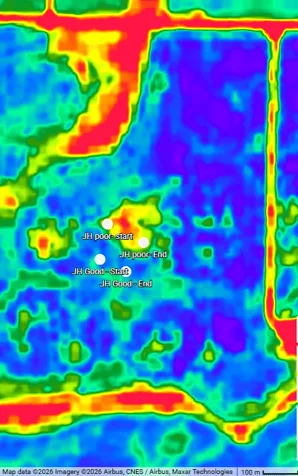
October 2025 satellite NDVI imagery for Cockaleechie sites (JH)
At some sites, the poor growth was confined to small patches or lower-lying parts of the paddock. At others, poor and good growth areas were more evenly spread through the paddock.
This is useful because it shows these issues are often spatial. The whole paddock may not need to be managed the same way.
NDVI imagery, yield maps and grower knowledge can help identify whether poor pulse performance is:
- isolated to small patches
- linked to drainage lines or lower slopes
- associated with particular soil types
- repeated across seasons
- large enough to justify a change in management
What does this mean for growers?
The main message from these investigations is that poor pulse growth in 2025 was not just caused by wet conditions in July.
In many cases, the wet period exposed soil constraints that were already present. Lentils were particularly sensitive, but faba beans were also affected where constraints were severe.
For growers, the best response is to diagnose the constraint before choosing a treatment.
Where low pH is the issue
Where soil pH is low, particularly on ironstone gravelly soils, lime should be considered before pushing pulses too hard in the rotation.
Low pH and aluminium can restrict roots and reduce pulse performance. Surface soil pH is important, but subsurface acidity also needs to be understood.
Where salinity is the issue
Where salinity is high, especially in lower landscape positions, crop choice and paddock zoning may be more useful than trying to fix the area with inputs.
Lentils are sensitive to salinity, so repeated poor performance in the same patches may indicate that these areas are better suited to more tolerant crops or managed separately.
Where boron is high
High boron is difficult to manage because there are few practical options to remove it from the soil.
If high boron is present in shallow subsoil layers, sensitive crops such as lentils may continue to struggle in those zones, especially in wet seasons or where roots are forced into constrained layers.
Where sodicity or dispersion is the issue
Gypsum may help where dispersion is mainly caused by sodicity.
However, the response is likely to be variable where salinity, boron or other constraints are also present.
Before applying gypsum at scale, it is worth checking whether the problem is actually dispersive soil structure, and whether the affected area is large enough to justify treatment.
Where drainage is the issue
Some poor growth patches were linked to lower-lying areas, shallow rock, poor internal drainage or water moving through the paddock.
In these cases, drainage, surface water movement and paddock layout may need to be considered.
However, any earthworks or deep ripping should be approached carefully, particularly where hostile subsoil layers contain salt, boron, dispersive clay or aluminium.
Watch repeated poor pulse patches
One important risk is that poor pulse growth can leave unused water in the soil profile.
If the same zones repeatedly grow poor pulse crops, they may use less water than the rest of the paddock. Over time, this can increase the risk of water movement, waterlogging or salinity issues, particularly in lower landscape positions.
This is especially important in tight lentil-cereal rotations, where the same constrained patches may underperform more often.
Practical next steps
For growers seeing repeated poor pulse patches, the most useful first step is to compare poor and good areas within the same paddock.
Useful checks include:
- soil pH at 0–10 cm and below 10 cm
- salinity and chloride
- boron
- soil texture and depth changes
- signs of dispersion
- soil moisture differences after crop growth
- root depth and root health
- NDVI or yield map patterns across seasons
A single soil test from the “average” paddock area may miss the real issue. Sampling poor and good zones separately is much more useful.
Final message
The 2025 season showed that some Lower EP pulse paddocks have strong yield potential, but also that lentils and faba beans can expose soil constraints quickly when conditions turn wet.
Poor patches were usually not caused by one simple issue. They were more often the result of wet conditions interacting with underlying soil constraints.
Understanding where these constraints occur, and whether they are manageable, is the key to making better decisions about pulse crop choice, paddock zoning, lime, gypsum, drainage and future rotations.
Acknowledgement
This work has been funded by the GRDC project ‘Development and extension to close the economic yield gap and maximise farming systems benefits from grain legume production in South Australia’, project code UOA2105-013RTX.
Thanks to the Lower EP farmers that allowed us to take samples and provided information for this project.