
Innovative Soil Technologies: Fostering Resilience and Climate-Smart Crop Production in Australia
Climate variability is significantly challenging dryland farming systems across Australia. Led by Adelaide University, the Climate Smart Soils project is addressing this challenge by trialling Innovative Soil Technologies (IST) that dramatically improve water infiltration and retention - the critical factors that determine crop success in a drying climate.
Working with nine regional grower groups across five states, our research evaluates soil treatment approaches across diverse soil types, delivering evidence-based insights that Australian farmers can act on today.
The challenge
Dryland farming across Australia faces increasing climate variability — reduced and erratic rainfall, intensifying heat events, and accelerating soil degradation. These pressures threaten food security and farm viability, demanding new approaches to soil and water management.
- Reduced and unpredictable rainfall patterns
- Declining soil water infiltration capacity
- Increasing frequency of extreme weather events
- Long-term soil health deterioration
Our approach
Innovative Soil Technologies (IST) offer a practical, evidence-based pathway to improved soil water efficiency. We’re rigorously testing these technologies in real farming conditions — not laboratory settings — to deliver actionable insights for growers.
- Improved water infiltration and retention
- Reduced runoff and evaporation losses
- Evidence across diverse soil types and states
- Farmer-led trials in real growing conditions
The trials
Trial sites have been established across South Australia, Western Australia, Victoria and New South Wales to test the effects of novel lime and gypsum application methods on soil amelioration and water use efficiency. Micronised lime and gypsum products will be compared with conventionally available local sources to assess the speed at which they are effective and how far they move through the soil profile. Products will be applied both to the surface and incorporated at depth.
On Eyre Peninsula, we have two trial sites being delivered by Josh Telfer, PIRSA on lower EP, one is a sodic site at Butler, the other is an acidic site at Edillilie. The trials have been established in May 2026.
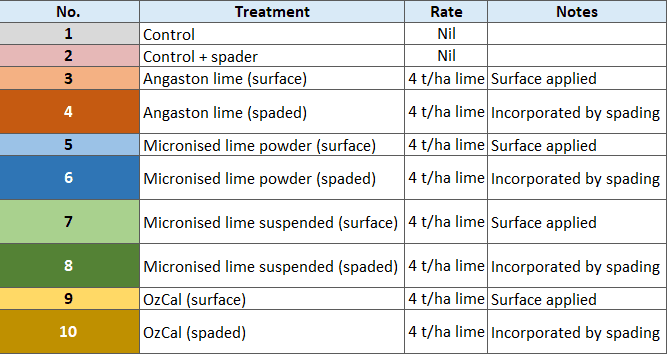
The Edillilie trial treatments are:
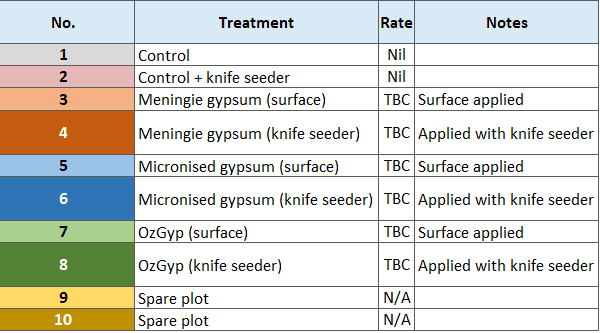
The Butler treatments are:
Watch this space for updates as the trials progress.
Further information
You can visit the project website here.
Or follow the project on Facebook, Instagram, and LinkedIn.
‘The Innovative Soil Technologies to Foster Resilience and Climate Smart Crop Production in Australia Project’, is supported by the Australian Government through funding from the Climate-Smart Agriculture Program under the Natural Heritage Trust.
Visit the overarching project website below
This page was last updated on 17 June 2026.
Share this project:
You Might Also Like
Far West Young Farmers – Drought Resilient Decision Making & Peer Learning Network
This project will support young farmers (18 to 35 years of age) in building resilience and improving decision-making in response to drought and seasonal variability. Through a series of peer-to-peer…
Water quality in extensive sheep grazing systems
Water quality factors such as total dissolvable salts, temperature, mineral composition, pH, and microbial load can differ between their sources. Further, run off from pasture herbicides and fertilisers may be…
Review of target values for soil performance indicators and their interdependencies
Complete a survey provided by Federation University identifying key factors and existing resources to support project implementation. This will include: • Identification and sharing of existing interpretation tables and assessments…
Eyre Peninsula internship in applied grains research 2027 (SA Drought Hub Contribution)
SA Drought Hub contribution towards grains research intern on EP for 2027, to be hosted by EPAG Research. This page was last updated on 17 June 2026.
Derisking the sowing program on EP – a comparison of different seeding systems and crops in 2026
The Minnipa Agricultural Centre operates two broadacre seeding systems. One is a tyne-based Horwood Bagshaw Precision Seeding System (PSS), the other is a RootBoot Razor, single disc hybrid system. The…
Eyre Peninsula internship in applied grains research 2027
To improve the capacity of grains research, development and extension in the Eyre Peninsula region through the employment of an annual intern within local research organisations in 2027. To further…
Soil CRC Adoption Activities
Soil CRC presentations at current group event Sandy Soils Amelioration day/half day with CSIRO Soil CRC presentations at current group event – MAC Field Day This page was last…
Plan 2 Profit upper EP 2026
Targeted at younger farmers on upper EP, this project aims to train a minimum of 10 farm businesses to: – Improve farm business financial literacy – Set goals and develop…
Risky Business Workshops for EP 2026
The “Risky Business” game to be delivered in person at 3 locations on EP, tentatively Wudinna, Rudall and Wirrulla (TBC). Up to 30 participants per workshop. Aim of improving understanding…
Managing and Mitigating Dry Saline Soils (Magnesia Patches) in South Australia
AIR EP is leading an investment in demonstration and extension of identification, management and amelioration of dry saline land. AIR EP & partners will deliver a program of work to…